
The 1Z0-136 Secret: What Most Candidates Miss

The Oracle WebLogic Server 14c Administrator Professional (1Z0-136) certification is designed for experienced system administrators and architects who manage, monitor, and configure Oracle WebLogic Server 14c domains. This professional-level credential validates a candidate's expertise in handling critical administration tasks, from initial domain creation and deployment to advanced clustering, security, and integration with modern cloud environments like OCI and container platforms. This comprehensive article delves into what the 1Z0-136 certification entails, outlines its structure, highlights the key syllabus areas, and reveals effective strategies to prepare, ensuring you don't overlook crucial aspects often missed by many candidates.
Examining the 1Z0-136 Credential
The Oracle 1Z0-136 exam serves as a benchmark for professionals responsible for the operational stability and performance of WebLogic Server environments. Achieving this certification demonstrates a candidate's proficiency in a wide array of administrative functions, signifying their capability to manage complex enterprise deployments. Understanding the exam's core details is the first step towards a focused and efficient preparation journey.
Key Aspects of the Certification Exam
The Oracle WebLogic Server 14c Administrator Professional certification validates hands-on skills required for the daily administration of WebLogic Server 14c. This includes everything from initial setup to advanced troubleshooting and performance tuning. The exam focuses on practical application and best practices, making real-world experience invaluable for candidates.
Understanding the Oracle 1Z0-136 Exam Structure
Candidates undertaking the Oracle 1Z0-136 exam should be aware of its logistical details to plan their study and testing experience effectively. The exam is structured to assess a broad range of administrative competencies, reflecting the comprehensive nature of the WebLogic Server 14c platform.
-
Exam Name: Oracle WebLogic Server 14c - Administrator Professional
-
Exam Code: 1Z0-136
-
Exam Price: USD $245 (Note: Pricing may vary by country or by localized currency, so candidates should check the official Oracle certification page for the most current information.)
-
Duration: 120 minutes
-
Number of Questions: 60
-
Passing Score: 65%
This structure indicates that candidates need not only a deep understanding of the topics but also the ability to answer questions accurately and efficiently within the given time frame. For further details on this certification and preparation materials, you can explore the Oracle 1Z0-136 certification details on DBExam.
Exploring Essential WebLogic Server 14c Architecture
At the core of the 1Z0-136 exam is a solid understanding of WebLogic Server architecture. This fundamental knowledge is crucial for creating, managing, and troubleshooting WebLogic domains effectively. Candidates must grasp how various components interact to form a robust and scalable application environment. This includes an in-depth look at the domain structure, server instances, and the role of the Administration Server.
Domain Components and Configuration Management
A WebLogic domain is the basic administrative unit in a WebLogic Server environment. It comprises one or more WebLogic Servers and their associated resources. Mastering domain creation involves understanding templates, configuration files, and the tools used for management. This is where many candidates might overlook the nuances of domain customization and best practices for domain partitioning.
-
Understand WebLogic Server architecture: Grasping the distinction between Administration Servers and Managed Servers, the role of domains, and the various directories within a domain installation is paramount. This foundational knowledge dictates how all subsequent configurations are applied and managed.
-
Create and manage WebLogic domains: This involves utilizing the Configuration Wizard or WLST (WebLogic Scripting Tool) to set up new domains, extend existing ones, and perform routine administrative tasks such as starting, stopping, and monitoring servers.
Effective domain management extends beyond initial setup to include understanding domain modes (development vs. production), resource allocation, and the impact of these choices on system performance and security. Proper configuration ensures the stability and efficiency of deployed applications.
Mastering WebLogic Resources and Clusters
Beyond individual server management, the 1Z0-136 certification emphasizes proficiency in handling WebLogic resources and configuring clusters for high availability and scalability. These topics are critical for enterprise-grade deployments where application uptime and performance are non-negotiable.
Configuring and Monitoring WebLogic Resources
WebLogic Server provides a rich set of resources that applications utilize, such as data sources for database connectivity, JMS (Java Message Service) for asynchronous messaging, and JNDI (Java Naming and Directory Interface) for object lookup. Efficient administration involves not only configuring these resources but also continuously monitoring their health and performance.
-
Monitor and control WebLogic resources: Implement comprehensive monitoring solutions using the WebLogic Server Administration Console, WLST scripts, or JMX (Java Management Extensions) to track resource utilization, identify bottlenecks, and take corrective actions. This includes monitoring JVM health, thread pools, and data source connection pools.
-
Set up and tune JDBC: Properly configuring JDBC data sources, connection pools, and multi-data sources is vital for application performance and reliability. Candidates should understand how to optimize data source settings, including initial capacity, maximum capacity, and statement caching, to prevent database connection issues.
-
Configure and monitor JMS services: Learn to deploy and manage JMS servers, destinations (queues and topics), connection factories, and message bridges. Monitoring JMS performance involves tracking message throughput, pending messages, and consumer activity to ensure efficient message delivery.
A common pitfall for candidates is underestimating the importance of performance tuning resources. While basic configuration might be straightforward, optimizing for specific workloads requires a deeper understanding of underlying mechanisms.
Implementing WebLogic Security Settings
Security is a paramount concern for any enterprise application server. The 1Z0-136 exam heavily features topics related to WebLogic security, covering authentication, authorization, and data integrity. This section requires a thorough understanding of security realms, providers, and policy enforcement.
-
Implement WebLogic security settings: This encompasses configuring default security providers, creating custom authentication and authorization mechanisms, and managing security policies for resources and applications. Understanding the WebLogic security framework is essential.
-
Manage security realms and providers: Work with various security providers (e.g., authenticators, authorizers, credential mappers) within a security realm. This includes configuring LDAP authenticators, RDBMS security providers, and managing users and groups effectively.
Neglecting the practical implications of security configuration can lead to vulnerable deployments. Candidates often miss the subtle differences between security policy types and their enforcement order, which can have significant security implications. For more insights on Oracle community discussions, consider resources like Oracle community discussions that can provide valuable context on security implementations.
Establishing and Managing WebLogic Clusters
WebLogic clusters are fundamental for achieving high availability, scalability, and load balancing for enterprise applications. The exam demands proficiency in designing, configuring, and managing clustered environments, including understanding replication, migration, and various cluster architectures.
-
Configure and manage WebLogic clusters: Learn to set up and administer clusters, including configuring server startup parameters, managing cluster-wide resources, and implementing failover and load balancing strategies. This is crucial for maintaining application uptime.
-
Deploy and manage applications in a clustered environment: Understand how to deploy applications in a clustered setup, ensuring that they are accessible and functional across all managed servers. This includes managing session replication and understanding deployment descriptors for cluster-aware applications.
Many candidates understand the concept of a cluster but struggle with the practical nuances of configuring cluster communication, managing state replication, and ensuring proper application deployment across cluster members. The subtle differences between in-memory replication, JDBC-based persistence, and file-based persistence for session management are frequently tested.
Deploying and Administering Applications
The ultimate purpose of WebLogic Server is to host and execute enterprise applications. The 1Z0-136 exam therefore places significant emphasis on the deployment lifecycle, from initial installation to ongoing management and monitoring of applications. This also extends to using advanced diagnostic and scripting tools.
Application Deployment Strategies
Deploying applications involves more than just placing an EAR or WAR file onto the server. It requires strategic planning for staging modes, deployment targets, and versioning. The exam tests candidates on various deployment methods and their implications.
-
Deploy and manage applications: Understand different deployment types (e.g., exploded directory, archived file) and deployment strategies (e.g., staging, non-staging, external_stage). Administer application lifecycle events such as starting, stopping, redeploying, and undeploying applications.
-
Ensure application stability: Monitor application health and performance using the Administration Console and custom metrics. Implement strategies for application tuning, including thread management, JVM heap adjustments, and connection pool optimization.
Candidates often miss the importance of understanding the impact of different deployment modes on application availability during updates, or the subtle differences between redeploying and updating an application for patches.
Leveraging WebLogic Diagnostics and Scripting
Effective administrators rely on robust diagnostic tools and scripting capabilities to maintain the health and performance of WebLogic Server environments. The 1Z0-136 exam assesses proficiency in using JMX for monitoring and WLST for automation.
-
Use WebLogic JMX Diagnostics and Scripting: Understand how to use JMX (Java Management Extensions) to monitor MBeans (Managed Beans) for server health, application performance, and resource utilization. Master WLST (WebLogic Scripting Tool) for automating administrative tasks, configuring domains, and deploying applications programmatically.
The true "secret" often missed here is the power of WLST. Many candidates focus solely on the Administration Console, but WLST offers unparalleled flexibility, repeatability, and automation capabilities, which are crucial in large-scale or DevOps-oriented environments. Scripting can significantly reduce manual errors and improve efficiency. This is a key area where advanced preparation pays off.
Modern WebLogic Deployments: Docker, Kubernetes, and OCI
The WebLogic Server landscape is constantly evolving, with increasing integration into cloud-native and containerized environments. The 1Z0-136 certification recognizes this shift by including topics on deploying WebLogic with Docker, Kubernetes, and provisioning domains on Oracle Cloud Infrastructure (OCI).
Containerizing WebLogic Server
Deploying WebLogic Server in containers offers benefits like portability, scalability, and resource efficiency. Candidates must understand the fundamentals of Docker and Kubernetes in the context of WebLogic deployments. This includes creating Docker images, managing containers, and orchestrating deployments with Kubernetes.
-
Deploy WebLogic with Docker/Kubernetes: Learn to containerize WebLogic Server applications using Docker images. Understand how to deploy and manage WebLogic domains and applications within a Kubernetes cluster, leveraging concepts like Pods, Deployments, Services, and Ingress.
This segment often trips up candidates who lack prior experience with containerization technologies. The exam focuses on WebLogic-specific considerations within these environments, such as persistent storage for domain configuration and effective logging.
WebLogic Management on Oracle Cloud Infrastructure (OCI)
Oracle Cloud Infrastructure provides a robust platform for running WebLogic Server. The exam covers provisioning and managing WebLogic domains directly on OCI, including integrating with OCI services for networking, storage, and identity management. For deeper understanding of such integrations, documentation like Oracle application documentation can be very helpful.
-
Provision and manage WebLogic domains on OCI: Understand how to deploy WebLogic Server instances and domains on OCI compute instances, leveraging OCI services for high availability and disaster recovery. This includes configuring virtual cloud networks (VCNs), load balancers, and block storage.
Proficiency in OCI concepts is becoming increasingly important for WebLogic administrators. The exam will test how WebLogic best practices translate to a cloud environment, especially regarding automation and resource management.
Crafting a Comprehensive Preparation Strategy for 1Z0-136 Success
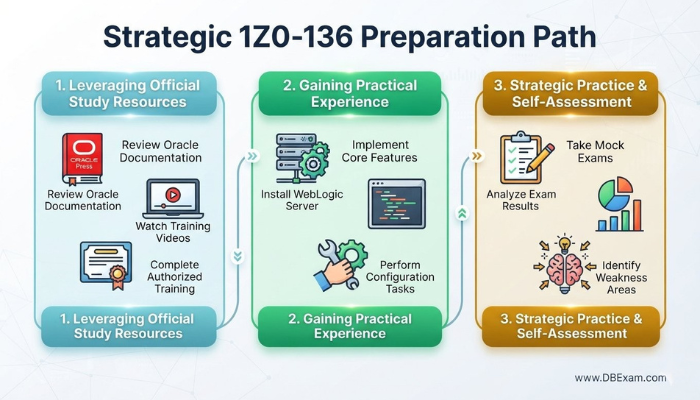
Passing the Oracle 1Z0-136 exam requires more than just reviewing the syllabus; it demands a structured and hands-on preparation strategy. Many candidates approach the exam with theoretical knowledge alone, which often leads to failure. The "secret" to success lies in combining official documentation, practical experience, and strategic practice.
Leveraging Official Study Resources
Oracle provides a wealth of documentation and training resources that should form the backbone of any study plan. These resources offer the most accurate and in-depth information on WebLogic Server 14c.
-
Official Documentation: Dive into the Oracle WebLogic Server 14c documentation. Pay particular attention to the administration guides, security guides, and clustering guides. These are the authoritative sources for all exam topics.
-
Oracle Training Courses: If feasible, consider official Oracle training courses. These instructor-led or on-demand courses are specifically designed to prepare candidates for certification exams and offer hands-on labs.
-
Online Communities: Participate in Oracle communities and forums. Engaging with other professionals can provide valuable insights, help clarify difficult concepts, and offer different perspectives on real-world challenges.
One common mistake is relying on outdated or unofficial materials. Always cross-reference information with the latest Oracle documentation for WebLogic Server 14c to ensure accuracy.
Gaining Practical Experience
Theoretical knowledge is insufficient for the 1Z0-136 exam. Practical, hands-on experience is critical to truly understand the concepts and their implications. Set up a personal lab environment to experiment with WebLogic Server 14c.
-
Install and Configure WebLogic: Perform a complete installation of WebLogic Server 14c. Practice creating and extending domains, configuring servers, and deploying sample applications.
-
Implement Key Features: Work through configurations for JDBC data sources, JMS services, security realms, and clustering. Simulate failover scenarios and practice monitoring using the Administration Console and WLST.
-
Scripting Practice: Develop and execute WLST scripts for common administrative tasks. This reinforces understanding of WebLogic MBeans and automation.
-
Containerization and Cloud: Experiment with deploying WebLogic on Docker and Kubernetes. If possible, explore provisioning WebLogic domains on a free tier of Oracle Cloud Infrastructure (OCI) to gain cloud-specific experience.
The more hands-on experience you accumulate, the better prepared you will be to tackle the practical scenarios presented in the exam questions. This is where most candidates miss out, focusing too much on memorization rather than application.
Strategic Practice and Self-Assessment
Regular self-assessment and targeted practice tests are vital for identifying knowledge gaps and improving exam readiness. This helps in understanding the exam format and managing time effectively.
-
Practice Questions: Utilize high-quality practice test questions that simulate the real exam environment. These help familiarize you with the question types and test your understanding of complex scenarios.
-
Review Explanations: Don't just focus on getting the right answer. Thoroughly review the explanations for both correct and incorrect answers. This process clarifies misconceptions and deepens your understanding.
-
Time Management: Practice answering questions under timed conditions to improve speed and accuracy. The 120-minute duration for 60 questions means approximately 2 minutes per question, so efficiency is key.
DBExam offers resources like Oracle 1Z0-136 practice test questions that can be instrumental in this phase of your preparation. Focusing on understanding the 'why' behind each answer rather than just memorizing responses is critical for true mastery.
Anticipating the Benefits of Oracle 1Z0-136 Certification
Earning the Oracle WebLogic Server 14c Administrator Professional certification brings several advantages to your professional career. It signals to employers and peers that you possess a verified level of expertise in a critical enterprise technology. This can translate into enhanced job prospects, career advancement, and increased earning potential.
Boosting Career Prospects and Role Effectiveness
The certification is a tangible validation of your skills, making you a more attractive candidate for specialized roles. It demonstrates a commitment to professional development and a proactive approach to mastering complex administration tasks.
-
Enhanced Job Opportunities: Oracle WebLogic Server continues to be a cornerstone technology for many large enterprises. Certified professionals are highly sought after for administrator, architect, and DevOps roles focusing on application server management.
-
Increased Earning Potential: Certifications often correlate with higher salaries and better compensation packages, reflecting the specialized skills and value you bring to an organization.
-
Professional Credibility: The 1Z0-136 credential enhances your professional standing, providing tangible proof of your ability to manage WebLogic Server environments effectively and securely.
For IT professionals aiming for roles such as Senior WebLogic Administrator, Middleware Engineer, or Cloud Application Administrator, this certification can be a significant differentiator in a competitive job market.
Solidifying Foundational Expertise for Future Growth
The knowledge gained during the preparation for the 1Z0-136 exam provides a strong foundation for exploring advanced Oracle technologies and cloud services. It positions you for continuous learning and adaptation to new challenges in the evolving IT landscape.
-
Foundation for Cloud Migration: With WebLogic Server increasingly deployed on OCI and container platforms, the certification provides the essential skills to manage these modern deployments and support cloud migration initiatives.
-
Mastery of Core Middleware Concepts: The principles of high availability, security, and performance tuning learned for WebLogic are transferable to other middleware platforms and enterprise application environments.
-
Contribution to Organizational Success: A certified administrator can ensure that WebLogic-dependent applications run optimally, securely, and with high availability, directly contributing to business continuity and operational efficiency.
This certification is not just about passing an exam; it's about building a robust skill set that remains relevant and valuable as enterprise architectures shift towards hybrid and multi-cloud strategies.
Conclusion
The Oracle 1Z0-136 certification for WebLogic Server 14c Administrator Professional is a robust credential for anyone serious about mastering enterprise middleware administration. The "secret" that most candidates miss isn't a hidden trick, but rather the crucial combination of deep theoretical understanding with extensive practical application, especially concerning automation with WLST and modern deployments on containers and OCI. By embracing comprehensive official study materials, gaining significant hands-on experience, and diligently practicing with quality questions, you can confidently navigate the exam and secure this valuable professional recognition.
Prepare to differentiate yourself in the competitive IT landscape by demonstrating your comprehensive expertise in Oracle WebLogic Server 14c. For further resources and to assess your readiness, visit DBExam's Oracle certification hub, where you can find valuable study materials and practice tests to refine your skills and ensure success.
FAQs
1. What is the Oracle 1Z0-136 certification designed for?
The Oracle 1Z0-136 certification, Oracle WebLogic Server 14c Administrator Professional, is for IT professionals who manage, monitor, and configure Oracle WebLogic Server 14c domains. It validates expertise in administration tasks, including deployment, clustering, security, and integration with modern environments like Docker, Kubernetes, and OCI.
2. How long is the Oracle 1Z0-136 exam and what is the passing score?
The Oracle 1Z0-136 exam has a duration of 120 minutes and consists of 60 questions. Candidates must achieve a passing score of 65% to earn the certification.
3. What types of skills does the 1Z0-136 certification validate?
The certification validates a broad range of skills, including understanding WebLogic Server architecture, creating and managing domains, configuring resources like JDBC and JMS, implementing security, managing clusters, deploying applications, and utilizing diagnostic tools. It also covers modern deployments with Docker/Kubernetes and on Oracle Cloud Infrastructure.
4. Is hands-on experience important for passing the Oracle 1Z0-136 exam?
Yes, hands-on experience is extremely important. The exam often presents scenario-based questions that require practical understanding beyond theoretical knowledge. Setting up a lab environment, practicing configurations, and using WLST for automation are crucial for effective preparation.
5. What are the career benefits of achieving the Oracle WebLogic Server 14c Administrator Professional certification?
Achieving this certification can lead to enhanced job opportunities in roles such as WebLogic Administrator or Middleware Engineer, increased earning potential, and stronger professional credibility. It also provides a solid foundation for managing WebLogic in cloud and containerized environments, aligning with current industry trends.
- Oracle WebLogic Server |
- 1Z0-136 |
- Oracle 1Z0-136 Questions and Answers |
- Oracle WebLogic Server 14c Certified Administrator Professional |
- 1Z0-136 Study Guide |
- 1Z0-136 Practice Test |
- Oracle WebLogic Server Administrator Professional Certification Questions |
- 1Z0-136 Sample Questions |
- 1Z0-136 Simulator |
- Oracle WebLogic Server Administrator Professional Online Exam |
- Oracle WebLogic Server 14c - Administrator Professional |
- 1Z0-136 Certification |
- WebLogic Server Administrator Professional Exam Questions |
- WebLogic Server Administrator Professional |
- 1Z0-136 Study Guide PDF |
- 1Z0-136 Online Practice Test |
- Oracle WebLogic Server 14c Mock Test |
- 1Z0-136 Test Questions |
- 1Z0-136 Exam Guide |
- 1Z0-136 Study Material |
- 1Z0-136 Syllabus |
- Oracle WebLogic Server 14c - Administrator Professional Syllabus |
- Oracle WebLogic Server Administrator Professional Prep Guide |
- 1Z0-136 Certification Exam Cost


