
Oracle 1Z0-1133-26 EPM Data Integration: Certification Practice Tests
Oracle 1Z0-1133-26 is the 2026 Oracle Cloud EPM Data Integration Implementation Professional exam: 50 multiple-choice questions in 90 minutes, a 68% pass mark, and a fee of USD 245 as of October 2026. Its questions check that you can connect sources, register applications, map members and periods, run and tune integrations, and move data with pipelines, the EPM Integration Agent and data maps.
Passing it earns the Oracle Cloud EPM Data Integration 2026 Certified Implementation Professional credential, the badge Oracle gives consultants who build the feeds that fill Planning, close and reporting applications. Before you plan your study weeks, try the 1Z0-1133-26 mock test once under time pressure; your weakest topics will show up faster there than in any reading list.
What does the 1Z0-1133-26 exam test?
The 1Z0-1133-26 exam tests the full life of an integration in Oracle Cloud EPM: describing Data Integration and the EPM Integration Agent, configuring source connections, registering source and target applications, building file-based and direct integrations with period, category and member mappings, running and reviewing loads, drill through, pipelines, performance tuning, agent-based extraction and data maps with Smart Push.
Data Integration is the component inside Cloud EPM business processes that brings figures in from general ledgers, files and other systems, translates them into the dimensions of the target application and loads them. It also moves data between EPM applications. Almost every Planning, Financial Consolidation and Close or Tax Reporting implementation needs it, which is why Oracle treats it as a separate implementation skill rather than a side topic of each business process.
The syllabus is organised by task. It starts with what the tool can do, moves through the setup an implementer performs once per project, then covers the daily operation of loads, and ends with the specialist routes: on-premises extraction through the agent and in-application movement through data maps. Questions follow the same practical line. You are rarely asked to recite a definition; you are given a requirement from a finance team and asked which mapping, setting or feature delivers it.
The sample items DBExam publishes for this exam show the tone. One describes five unrelated department codes that must all land on one entity and asks for the mapping type. Another describes a column of manual adjustments where drill through offers nothing and asks why. A third weighs an overnight data map schedule against Smart Push for a planner who wants to see their numbers before going home. Each one rewards knowing how the feature behaves, not what it is called.
Oracle's recommended training is the Become a Certified Oracle Cloud EPM Data Integration Implementer learning path on Oracle MyLearn. The Oracle 1Z0-1133-26 exam page links to that path, shows the fee that applies in your country and is where you book a session.
How is the 1Z0-1133-26 exam structured, scored and priced?
The exam allows 90 minutes for 50 multiple-choice questions, and the pass mark is 68%. Oracle prices the exam at USD 245 as of October 2026, with local pricing that can differ by country or currency. The exam belongs to the Oracle Cloud EPM category and is versioned for the Oracle EPM Platform 2026 release.
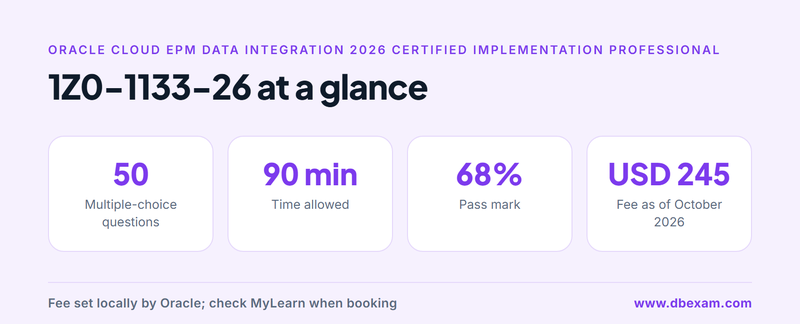
A 68% pass mark on 50 questions means 34 must be right. You can get 16 wrong, which sounds generous until you notice how many topics share them. With ten syllabus sections and no published weights, a candidate who skips two sections entirely could easily lose a dozen questions before making a single mistake elsewhere.
The clock gives you just under two minutes per item. Most stems on this exam are two to four sentences, shorter than on architecture exams, so time pressure usually comes from hesitation rather than reading. Commit to an answer on the first pass whenever you can rule out two options, flag the rest, and use the last quarter of an hour for the flagged items.
Some questions ask for more than one answer. In this exam those items often pair a setting with its consequence, for example a period mapping level and the applications it affects. Judge each option separately against the stem instead of hunting for two options that sound alike.
Because the exam carries a year suffix, its content follows the 2026 platform. Data Integration has replaced most of the older Data Management screens, and the exam is written for the Data Integration interface. Older study notes that describe import formats and locations in Data Management terms still explain the ideas, but the names and screens you will be asked about are the current ones.
Which topics make up the 1Z0-1133-26 syllabus?
The 1Z0-1133-26 syllabus has ten sections: understanding Data Integration, source connections, registering applications, creating integrations, running integrations, drill through, pipelines, performance, the EPM Integration Agent, and data maps with Smart Push. Oracle's published syllabus gives no percentage weight per section, so plan to cover all ten rather than betting on a few.
Understanding Data Integration
This opening section asks you to describe what Data Integration does and what the EPM Integration Agent adds. Know the difference between loading data from an external source, exporting data out of EPM, and moving data between EPM applications, and know that the agent exists for sources Cloud EPM cannot reach directly.
Configuring Source Connections
Here you describe and set up source connections, the stored details Data Integration uses to reach systems such as Oracle ERP Cloud or other Oracle cloud services. A useful rule from the sample questions: when a source moves to a new endpoint but nothing else changes, you update the connection and leave every integration built on it untouched.
Registering Applications
You must identify source and target application categories and the types each supports, then define and register an application with its details and options. Registration tells Data Integration what an application is and which dimensions it exposes. Expect questions that ask which category fits a file, a cloud source, an EPM business process or a data export.
Creating Data Integrations
This is the largest section by number of objectives. It covers period and category mapping, global, application and source period mappings, file-based integrations, direct integrations and integrations from other data sources. Member mapping sits underneath all of it: the rules that translate source values into target members, using types such as Explicit, In, Between and Like.
Running Data Integrations
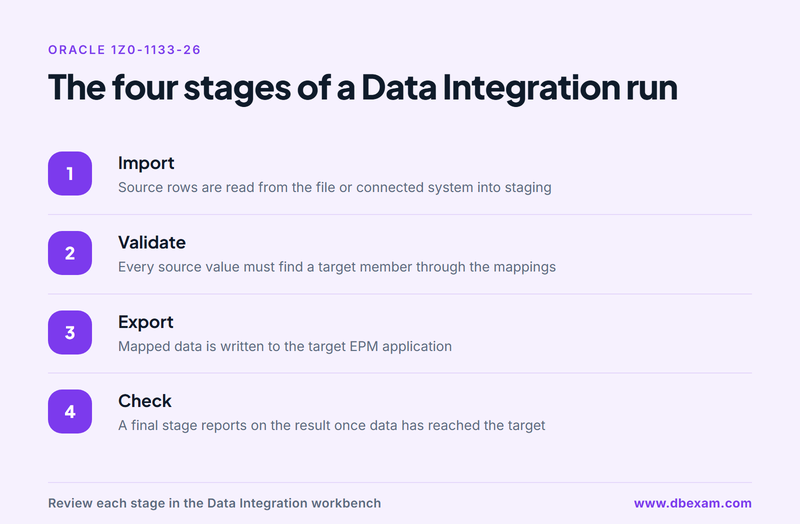
Running covers starting a load, reviewing data in the workbench and viewing process details. The workbench shows the import, validate, export and check stages, and process details hold the log for each run. Know what each stage means for the figures and where to look when one fails.
Navigating to Source Systems Using Drill Through
You must describe the role of drill through and set it up. Drill through lets a user move from a number in an EPM form back to the rows that produced it in Data Integration and, where supported, on to the source system. Figures typed in by hand have no source rows behind them, so they offer nothing to drill into.
Running Jobs Using Pipelines
Pipelines group several jobs, such as integrations and other EPM tasks, into stages that run in a defined order. The objectives are to create and modify pipelines and to run them. Expect questions on sequencing, on what happens when one job in a stage fails, and on why a pipeline is easier to operate than a set of separately scheduled jobs.
Optimizing Performance in Data Integration
This section covers optimising integrations, analysing job logs, tuning and other performance considerations, and troubleshooting. It rewards practical judgement: which mapping types cost the most to evaluate, when a lighter workflow mode helps, how detailed logging affects a run, and how to read a log to find the stage where a load slowed down or failed.
Extracting Source Data and Metadata Using EPM Integration Agent
You must install, configure and start the EPM Integration Agent and run jobs through it. The agent runs inside your own network, extracts from on-premises sources such as relational databases, and passes the results to Cloud EPM. Know its two ways of working: the cloud calling the agent directly, or the agent polling the cloud for work.
Moving Data with Data Maps
The final section covers the role of data maps and Smart Push, creating and managing data maps, configuring Smart Push and moving data with both. A data map defines how data moves between cubes or applications; Smart Push runs that movement for the data on a form when a user saves it, which is what makes figures visible in a reporting cube straight away.
The 1Z0-1133-26 syllabus page on DBExam lists every objective in this order, and it makes a handy tick list while you study.
Which 1Z0-1133-26 topics trip up experienced EPM consultants?
Mappings cause the most lost marks on 1Z0-1133-26, even for experienced EPM consultants. Questions separate member mapping types by exactly how they match, separate the three period mapping levels by scope, and separate category mapping from what was chosen at registration. People who build mappings by habit often know what works without being able to say why the alternatives fail.
Take member mapping types. Explicit maps one source value to one target member. In maps a listed set of unrelated source values to one member. Between maps a continuous range. Like uses wildcard patterns. The exam likes stems where two of these would technically work but one is clearly intended, such as five unrelated codes that share no pattern, where In is the fit and a broad Like pattern would catch values nobody asked for.
Period mapping is the second trap. Global mapping is defined once and serves every application that follows the same calendar. Application mapping overrides it for one target. Source mapping deals with the calendar of a particular source system. A company with one fiscal calendar across all of its EPM applications needs only the global level, and answers that suggest repeating the work per application miss the point of the hierarchy.
Consultants who come from the older Data Management tool face a vocabulary shift. The ideas carried over, but the screens, names and some behaviour changed with Data Integration. If your experience is mostly with import formats and locations, spend time in the current interface so you recognise the terms used in questions.
Planning specialists who have never installed the EPM Integration Agent tend to find that section the least familiar. It touches on Java, network access, configuration files and services running on a company server, which feel far from building forms and rules. Reading one installation guide end to end, and noting what must be in place before the agent starts, removes most of the uncertainty.
What does a 1Z0-1133-26 integration look like from file to Check?
A typical 1Z0-1133-26 scenario follows one integration end to end: a source is connected or a file is defined, applications are registered, periods, categories and members are mapped, the load runs through the import, validate, export and check stages, and the result is reviewed, drilled into, scheduled in a pipeline or pushed onward with a data map.
The walkthrough below uses a monthly general-ledger file loaded into a Planning application. It is an illustration of the syllabus, not a question from the exam.
Step 1: Register and define
The Planning application is registered as the target, and the ledger file is described as a source with its delimiter and the column that holds each dimension. If the same ledger were Oracle ERP Cloud rather than a file, a source connection and a direct integration would replace the file definition, and the rest of the flow would be the same.
Step 2: Map periods and the scenario
The company runs one fiscal calendar, so a single global period mapping aligns the ledger months with the Planning periods. A category mapping relates the ledger's actuals to the Actual scenario. Choosing a category when registering the application does not replace this mapping, a distinction one of the published sample questions tests directly.
Step 3: Map members
Account and entity values in the file are translated with member mappings. Most accounts map one to one with Explicit rules; a range of cost centres rolls into one entity with a Between rule; a handful of unrelated codes share an In rule. Anything left unmapped will fail at validation, which is exactly where you want to catch it.
Step 4: Run and read the workbench
The run passes through import, validate, export and check. Import brings the rows into staging. Validate confirms each row has a target member. Export writes the data to Planning. Check then reports on the loaded result. If validation fails, the workbench shows which source values had no mapping, and process details hold the full log.
Step 5: Operate it
Once the load is reliable, a pipeline runs it together with the business rule that aggregates the data, in the right order and on a schedule. Drill through is set up so planners can trace a figure back to its ledger rows. A data map then copies the results into the reporting cube, and Smart Push on the input form keeps that cube current whenever a planner saves.
Does Oracle provide a practice test or question bank for 1Z0-1133-26?
Oracle prepares candidates for 1Z0-1133-26 through its MyLearn learning path for Data Integration implementers, and it offers no question bank for sale. DBExam's 1Z0-1133-26 practice test is an independent timed simulator written to the published syllabus and exam format; it is not Oracle content.
Think of the two as teaching and testing. The learning path shows you how connections, registrations, mappings, pipelines and data maps are built. A timed mock test shows whether you can pick the right one from four plausible options in under two minutes, and it exposes gaps that a second read of the course would hide, because recognising a screen is easier than choosing between two mapping types under pressure.
Our mock test keeps the real exam's shape: 50 items, 90 minutes on the clock and a 68% target score. Items are written as short implementation scenarios, every attempt is timed, and your result history records the answer you chose next to the correct one so you can see which syllabus sections keep costing you marks. Access lasts two months with unlimited attempts. Free 1Z0-1133-26 sample questions are also on DBExam if you want to see the style first.
Stay away from collections sold as leaked exam content. Using them breaches Oracle's certification terms, and for an exam versioned by year they are often built for an older release. A mapping or workbench answer that was right for Data Management may describe a screen that no longer exists in Data Integration.
How should you prepare for 1Z0-1133-26?
Allow six weeks for 1Z0-1133-26 at roughly six to eight hours a week, and spend at least half of that time in a Cloud EPM environment. Build one file-based and one direct integration end to end, then add drill through, a pipeline, the agent and a data map, and finish with timed mock tests aimed at your weakest sections.
Week 1: Concepts, connections and registration
Read the overview of Data Integration and the agent, then set up a source connection and register a target and a source application. Note every category and type you see in the registration screens. End the week with a timed mock test to find your baseline.
Week 2: Mappings
Build global, application and source period mappings and a category mapping. Then create member mappings of each type for the same dimension and test which source values each one catches. Write one sentence per type explaining when you would choose it over the others.
Week 3: Building and running integrations
Create a file-based integration and a direct integration, run both, and work through the workbench stages. Break a mapping on purpose and read the validation errors and the process log, because the exam expects you to know where problems surface.
Week 4: Drill through and pipelines
Set up drill through and test it from a form, including a cell with a manual entry. Then build a pipeline that runs an integration and a business rule in sequence, run it, and note what happens when one job fails.
Week 5: Performance, the agent and data maps
Study the tuning options and read a long job log from start to finish. Install and start the EPM Integration Agent if you can, or follow the installation guide step by step if you cannot. Create a data map, enable Smart Push on a form and compare the two ways of moving data.
Week 6: Timed mock tests
Sit at least two full mock tests on different days, list every miss by syllabus section and revisit only those topics. Book the exam once you score well clear of 68% on two attempts in a row.
Mistakes that cost marks
Learning mapping types by name only. Know which values each type catches and which it would catch by accident.
Repeating period mappings per application. Use the global level when the calendar is shared; override only where a target differs.
Skipping the agent. It is a whole syllabus section, and its installation and run modes produce straightforward marks for anyone who has read them.
Confusing data maps with Smart Push. The data map defines the movement; Smart Push triggers it for a form's data on save.
Ignoring the logs. Troubleshooting questions are answered from process details and job logs, so practise reading them.
Where do you find your 1Z0-1133-26 score, and what follows a pass?
Your 1Z0-1133-26 result is posted to Oracle CertView, which you reach from your MyLearn account. A pass adds the Oracle Cloud EPM Data Integration 2026 Certified Implementation Professional credential to your Oracle record, together with a digital badge to attach to your CV, email signature or online profiles.
The report confirms the outcome and can indicate the areas where answers were wrong. If you fall short, treat that list as your plan for the next attempt: work through those sections in an environment, take a new timed mock test and review the retake conditions on MyLearn before choosing a date.
For implementation partners and in-house EPM teams, this credential shows that you can own the data side of a project: getting ledger and operational data into EPM correctly, keeping it flowing every period and letting users trust and trace what they see. Clients often judge an EPM rollout by whether the numbers tie out, and that is the work this exam covers.
Oracle updates Data Integration with each platform release, so keep the Administering Data Integration documentation bookmarked and check what changed whenever a new update reaches your environment.
FAQs
How many questions does 1Z0-1133-26 have, and what is the time limit?
1Z0-1133-26 gives candidates 90 minutes for 50 multiple-choice questions. Stems are fairly short implementation scenarios, so the main risk is hesitating between two plausible mapping or setting choices. Answer what you can on a first pass, flag the rest and return with the time saved.
What mark do you need to pass 1Z0-1133-26?
Oracle sets the 1Z0-1133-26 pass mark at 68%, so 34 of the 50 questions must be answered correctly. The syllabus has ten sections and publishes no weights, which means leaving out even two of them can cost more marks than the 16-question margin allows.
What is the fee for the 1Z0-1133-26 exam?
Booking 1Z0-1133-26 costs USD 245 as of October 2026. Oracle may charge a different amount in some countries or currencies, and local tax can apply. The price shown in your MyLearn account when you book is the one you pay, so confirm it there along with the retake rules.
What certification comes with passing 1Z0-1133-26?
A pass on 1Z0-1133-26 brings the Oracle Cloud EPM Data Integration 2026 Certified Implementation Professional title, listed in the Oracle Cloud EPM category. It suits consultants and EPM administrators who build and run the feeds that load ledger and operational data into Cloud EPM applications.
Does the 1Z0-1133-26 syllabus publish topic weights?
No. Oracle lists ten syllabus sections for 1Z0-1133-26, from understanding Data Integration to data maps and Smart Push, without a percentage against any of them. Creating Data Integrations has the most objectives, but every section can appear, so cover all ten before you book.
Can you buy Oracle's own question bank for 1Z0-1133-26?
Oracle sells no question bank for 1Z0-1133-26. Its preparation is a MyLearn learning path for Cloud EPM Data Integration implementers. DBExam's 1Z0-1133-26 practice test is a separate, timed simulator built around the published topics and question format; Oracle does not produce it.
- Oracle Cloud EPM Data Integration Implementation Professional Certification Questions |
- Oracle Cloud EPM Data Integration Implementation Professional Online Exam |
- Cloud EPM Data Integration Implementation Professional Exam Questions |
- Cloud EPM Data Integration Implementation Professional |
- Oracle Cloud EPM Data Integration Implementation Professional Prep Guide |
- Oracle Cloud EPM |
- 1Z0-1133-26 |
- Oracle 1Z0-1133-26 Questions and Answers |
- Oracle Cloud EPM Data Integration 2026 Certified Implementation Professional |
- 1Z0-1133-26 Study Guide |
- 1Z0-1133-26 Practice Test |
- 1Z0-1133-26 Sample Questions |
- 1Z0-1133-26 Simulator |
- Oracle Cloud EPM Data Integration 2026 Implementation Professional |
- 1Z0-1133-26 Certification |
- 1Z0-1133-26 Study Guide PDF |
- 1Z0-1133-26 Online Practice Test |
- 1Z0-1133-26 Test Questions |
- 1Z0-1133-26 Exam Guide |
- 1Z0-1133-26 Study Material |
- 1Z0-1133-26 Syllabus |
- Oracle Cloud EPM Data Integration 2026 Implementation Professional Syllabus |
- Oracle EPM Platform 2026 Mock Test


