
Oracle 1Z0-1156-26 Practice Test: Syllabus, Exam Questions, and Preparation Guide
Oracle 1Z0-1156-26 is the 2026 implementation exam for Oracle Utilities Market Settlements Management Cloud Service: 50 multiple-choice items, a 90-minute limit, a passing score of 68% and a USD 245 fee as of November 2026. It checks whether you can set up market participants and contracts, bring in standalone measurement data, aggregate it with loss factors and estimation, and run settlement transactions against market awards.
Passing it makes you an Oracle Utilities Market Settlements Management Cloud Service 2026 Certified Implementation Professional, the credential for consultants who configure settlements for distributors, suppliers and system operators. Before you plan a single study week, sit the 1Z0-1156-26 practice test once against the real clock; the sections you guess on will tell you where the weeks should go.
What does the 1Z0-1156-26 exam test?
The 1Z0-1156-26 exam tests the configuration work behind an energy market settlement in Oracle Utilities Market Settlements Management Cloud Service: market participants, service providers and contracts; standalone measurement data brought in from outside; settlement units with their loss factors; the forecasting, backcasting and estimation rules that fill gaps; standard and dynamic aggregation; market product sets, products and awards; settlement subscriptions and their transactions; and the process flows that tie the stages together.
Market Settlements Management is the Oracle Utilities cloud service that works out who owes what to whom once the energy has flowed. A distribution company has to tell the grid operator how much each supplier's customers drew in every hour; a supplier has to reconcile what it was billed against what its meters recorded; a provider of last resort has to allocate load it inherited to the products it is paid for. The service takes measured and estimated data, sums it along the dimensions the market cares about, applies losses and rules, and produces transactions that can be sent, audited and disputed.
The exam sits squarely on the implementation side of that story. You are not asked to recite tariff law or to compare wholesale markets in different countries. You are given a situation at a named utility, a requirement from its settlement team and four or five configuration choices, and you pick the one that delivers the requirement with the least fuss. Knowing where a setting lives, what it defaults from and what happens when it is left blank matters more than knowing the name of the screen.
Because the service shares its measurement foundation with Oracle Utilities Meter Solution, several syllabus items use vocabulary from that world: measuring components, initial measurements, VEE rules, factor values and business objects with a D1 prefix. Candidates who have implemented meter data management will recognise most of it. Candidates arriving from the market or trading side should budget time for that foundation first, because the settlement-specific objects are built on top of it.
Oracle's recommended training is the Oracle Utilities Market Settlements Management learning path on MyLearn, and the Oracle 1Z0-1156-26 exam page is where you check the fee in your currency and book a sitting.
What are the 1Z0-1156-26 exam format, pass mark and fee?
You get 90 minutes to answer 50 multiple-choice items on 1Z0-1156-26, and 68% passes. The fee Oracle lists is USD 245 as of November 2026, and it may differ by country or localised currency. The exam belongs to the Oracle Utilities category and is versioned to the 2026 release of the cloud service.
| Item | Detail |
|---|---|
| Exam code | 1Z0-1156-26 |
| Exam name | Oracle Utilities Market Settlements Management Cloud Service 2026 Implementation Professional |
| Credential | Oracle Utilities Market Settlements Management Cloud Service 2026 Certified Implementation Professional |
| Number of items | 50, all multiple choice |
| Time limit | 90 minutes |
| Score to pass | 68% |
| Exam fee | USD 245 in November 2026; local pricing may differ |
Sixty-eight percent of 50 is 34 correct answers, so you may miss 16. Spread across eight syllabus sections that carry no published weights, that margin is thinner than it looks: a candidate who has never opened the aggregation or process-flow areas can lose most of it on those two topics alone. Treat every section as examinable.
Ninety minutes for 50 items works out at 108 seconds each. The stems are scenario-based and often run to three or four sentences with a named utility, its market role and the constraint that matters, so read for the constraint. Phrases such as least configuration per component, no custom lookup value or cannot respond to requests are the hinge of the question; the rest is setting.
A handful of items ask you to choose two statements. These tend to probe a process end to end, for example how an interval file and a scalar file are each turned into initial measurements. Evaluate each statement on its own merits against what the service does; the two right answers rarely resemble each other.
The year suffix in the code means the content tracks the 2026 service. Older study notes written for on-premises Meter Data Management will still explain measuring components and VEE correctly, but settlement objects such as market product sets, settlement subscriptions and process-flow track formats belong to the cloud service and are described in the current Oracle Utilities Market Settlements Management documentation.
Which eight sections make up the 1Z0-1156-26 syllabus?
The published 1Z0-1156-26 syllabus has eight sections: market structures and participants; standalone data and initial measurements; settlement units and loss factors; forecasting, backcasting and estimation; aggregation processes; market products, awards and contracts; settlement subscriptions and transactions; and process flows. Oracle does not assign a percentage to any of them, so the plan below gives each section the attention its objective list suggests.
Analyze Market Structures and Participants
This section asks you to identify the roles and functional categories of market participants in wholesale and retail markets, explain what each one is responsible for, and evaluate how market relationships and service providers shape the settlement process. It closes with configuring market participant contracts and contract types, and validating that the mapping between participants and contracts is correct. Know the difference between an independent system operator, a distributor, an energy service provider and a schedule coordinator, because a question may describe a function and ask which role performs it.
Manage Standalone Data and Initial Measurements
Standalone data is measurement that does not come from a meter the service owns: zonal loads from the system operator, day-ahead prices from a publisher, profiles from a third party. You classify the types and their purposes, distinguish initial measurement data from transactional data, pick storage and file formats, and design import routes through standard interfaces or file upload. The second half covers centralised scheduling: processing timetable types, automated data requests and the monitoring of the resulting process flows.
Develop and Interpret Settlement Units and Loss Factors
A settlement unit organises data for a settlement calculation, and you must configure its core components to match business and regulatory needs. The section then separates four configuration elements that beginners blur together: dimensions, factor codes, classes and factor values. It finishes with loss factors, their categories such as technical and non-technical losses, the algorithms that apply them and how they feed into aggregated results.
Apply Forecasting, Backcasting, and Estimation
Forecasting projects usage forward to fill a settlement that must be submitted before the data exists; backcasting rebuilds a past period once better information arrives. You compare the two, recognise when each closes a settlement gap and explain how the choice affects results and compliance. Estimation rules, key parameters and VEE rules follow, then interval proxy day estimation with its weather-station selection and comparison options, and finally measuring component comparison methods for accuracy.
Design and Execute Aggregation Processes
This is the longest objective list on the syllabus. You differentiate standard from dynamic aggregation, set up aggregation groups, aggregation schedules and measuring component sets, configure data sources with template SQL, develop measuring component types for dynamic aggregation, run and track an aggregation group, and know where aggregated results are stored for reporting. The processing timetable, SQL templates and the dimension scanning process each get their own objective.
Evaluate Market Products, Awards, and Contracts
Here you map the hierarchy from market product set to product to award, describe what each level holds and explain how awards relate to energy contracts. Market contracts and contract types get a close look: the attributes a contract needs, how its terms shape the award process, and the steps for activating and updating one. The section ends with the downstream effect of contract changes on settlement accuracy and the reporting and audit considerations that follow.
Operate and Troubleshoot Settlement Subscriptions and Transactions
A settlement subscription holds the aggregation rules, calculation groups and calculation rules, including array math rules, that generate settlement transactions. You configure the subscription, generate transactions from it and make sure the settings drive market award allocation. Then comes operations: reading transaction logs, checking outbound messages and communications, resolving exceptions through To Do management and allocating awards inside live transactions.
Manage and Optimize Process Flows
The final section covers the end-to-end settlement process flow, the panels and track formats that present it, and the different process flow types available. The objectives are scenario based: you are expected to recommend a configuration for a stated business need and to solve a described process-flow problem using established practice.
DBExam's 1Z0-1156-26 syllabus page sets out each objective under these eight headings, and ticking it off section by section is a sound way to track revision.
How do the four layers of a 1Z0-1156-26 settlement fit together?
A market settlement in Oracle Utilities Market Settlements Management is built in four layers, and the 1Z0-1156-26 syllabus follows them in order: the market layer of participants, service providers and contracts; the data layer of standalone measuring components and initial measurements; the aggregation layer of groups, measuring component sets, template SQL and loss factors; and the settlement layer of subscriptions, calculation groups, transactions and awards.
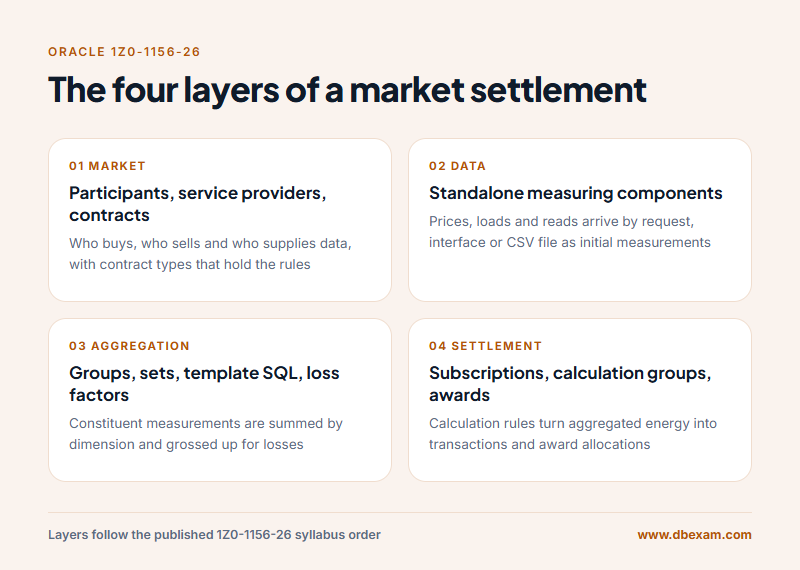
The market layer names everyone involved. A market participant record holds a role; a service provider record describes an external party that sends or receives data and can carry a default processing timetable; a market contract type sets the rules a contract of that category must obey, such as whether a buyer may hold more than one valid contract at a time. Get this layer wrong and every later layer inherits the error.
The data layer brings numbers in. Each external series, whether an hourly zonal load or a daily price, is represented by a standalone measuring component. Data reaches it in one of three ways: a standalone data request that the service sends on a timetable, a feed from an external system through the measurement import interface, or a CSV file uploaded by hand with Load IMDs. Whichever route is used, the result is an initial measurement that passes through VEE before it becomes final.
The aggregation layer turns thousands of constituent measurements into the totals the market settles on. A measuring component set defines which constituents qualify, an aggregation data source supplies the template SQL that finds them, the dimension scanner discovers the combinations of supplier, zone, loss class or whatever dimensions you configured, and the aggregation group runs the sums on its schedule. Loss factors gross the totals up to the point where the market measures them.
The settlement layer does the arithmetic the market pays for. A settlement subscription points at the aggregated data and at a calculation group whose rules, including array math rules, produce settlement transactions for each calculation period. Market awards are allocated inside those transactions, outbound messages carry the results to counterparties, and exceptions land in To Do entries for someone to resolve.
Questions on 1Z0-1156-26 frequently cross these layers. A stem about a missing settlement transaction may turn out to be a data-layer problem with a request that never ran, or a market-layer problem with a contract that was never activated. When you read a scenario, locate the layer where the symptom appears and then ask which earlier layer could have caused it.
Where do candidates lose marks on 1Z0-1156-26?
Most lost marks on 1Z0-1156-26 come from pairs of concepts that look alike: standard versus dynamic aggregation, forecasting versus backcasting, market products versus market awards, dimensions versus factor codes, and a setting placed on a measuring component type versus the same setting placed on each component. The published sample questions test these pairs directly, and so does the exam.
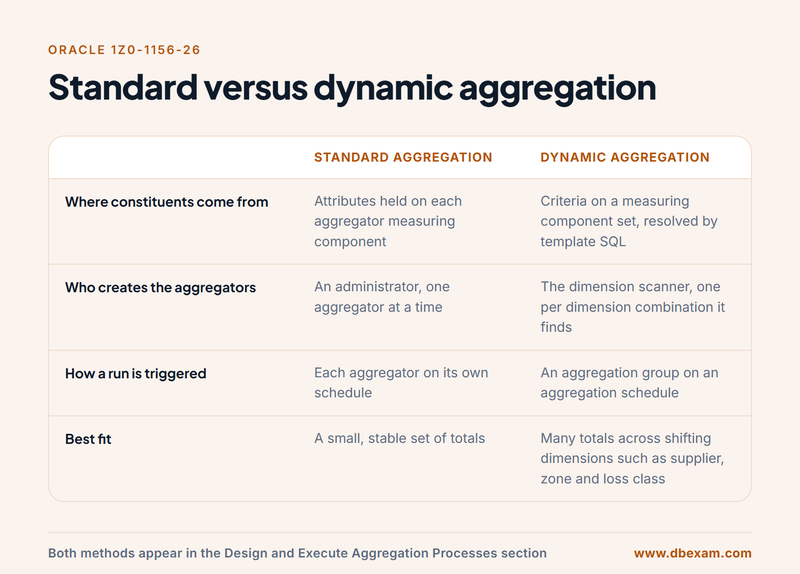
Take standard versus dynamic aggregation. In standard aggregation an administrator creates each aggregator measuring component by hand, and the constituents are found from attributes held on that aggregator. In dynamic aggregation the administrator describes the constituents once, as criteria on a measuring component set, and lets the dimension scanner discover every combination of dimension values present in the data, creating an aggregator for each. Standard aggregation suits a small, stable set of totals; dynamic aggregation suits a market where suppliers, zones and loss classes change from month to month. A question that mentions a new criterion on a measuring component set is a dynamic-aggregation question, and the SQL it extends is the dimension scanner SQL, not the aggregation SQL or the find-constituents SQL.
Forecasting versus backcasting trips up candidates who treat them as synonyms for estimation. Forecasting fills a settlement period that has not finished, or whose data has not arrived, so that a submission deadline can be met. Backcasting revisits a period that has already been settled on provisional data and recalculates it with the actuals. The exam wants you to name which one a scenario requires and to say what the choice does to the result and to compliance with the market's timetable.
Products versus awards is a hierarchy question. A market product set groups products for one market and one service type; a market product describes something that is settled, such as supply of last resort; a market award is the allocation of that product to a participant for a period. Adding gas products to an electricity product set, or hanging awards straight off a contract type, both break the hierarchy, and distractors built on those mistakes appear in the sample set.
Dimensions versus factor codes matters in the settlement-unit section. A dimension is an axis along which data is sliced, such as loss class or supplier. A factor code identifies a factor whose value varies, a class groups factor values, and a factor value is the number that applies for a given dimension combination and date. When a scenario asks how two populations in one aggregation group can each receive a different loss calculation, the answer is a dimension, because the dimension is what lets the aggregation tell the populations apart.
Type-level versus component-level settings is the quiet one. Many attributes, including the processing timetable type and the service provider for a standalone data request, can be set on the measuring component type and inherited, or set on each component individually. When a stem asks for the least configuration per component, the answer is to set the value once on the type and leave it blank on the components. When it asks for one component to behave differently, the answer is an override on that component.
Two further patterns from the sample questions are worth memorising. First, when an uploaded interval file contains a gap longer than one interval, a new initial measurement starts after the gap, while each row of a scalar file becomes its own initial measurement. Second, when a settlement subscription has no calculation group in effect for a period, the transaction runs the fallback group named on the settlement subscription type rather than failing or running all valid groups.
Does Oracle offer its own practice test or a question bank for 1Z0-1156-26?
Oracle's preparation for 1Z0-1156-26 is its MyLearn learning path for Oracle Utilities Market Settlements Management; Oracle does not sell a separate question bank for this exam. DBExam's 1Z0-1156-26 simulator is our own timed product, modelled on the published objectives and the real question format. Oracle neither writes nor endorses it, and it contains none of Oracle's exam items.
The learning path and a simulator do different jobs. The path teaches you how a measuring component set, an aggregation group or a market contract type is configured, with the service in front of you. A simulator checks whether you can pick the right configuration from four plausible ones in under two minutes, with no service in front of you, which is the condition you will actually face at the test centre or in an online-proctored session.
Our practice test mirrors the real shape: 50 questions, 90 minutes and a 68% target, drawn at random from a bank of more than 195 scenario questions, with a 25-question mini version for shorter sessions. Each sitting runs against the clock, and the result history keeps your chosen answer next to the correct one, so after three or four attempts you can see which of the eight sections keeps costing you. Access runs for two months with unlimited attempts, and free 1Z0-1156-26 sample questions are published on DBExam if you want to judge the style first.
Avoid anything sold as real exam questions. Using such material breaches Oracle's certification candidate agreement, and for a yearly versioned cloud exam the content is often a release behind. A scenario answer that was right for an earlier release of the service may point to a configuration path that the 2026 release has moved or replaced.
How should you prepare for 1Z0-1156-26 in six weeks?
Plan six weeks for 1Z0-1156-26 at roughly seven hours a week, with half or more of it spent configuring a test environment rather than reading about one. Build one market, one data feed, one aggregation group and one settlement subscription end to end, then widen each layer, and finish with timed mock tests focused on the sections where you still lose marks.
Week 1: Market layer and the measurement foundation
Create market participants for each role in a small retail market, add a service provider and define two contract types with different rules. If you are new to the meter data foundation, spend the rest of the week on measuring components, initial measurements and VEE. Sit a timed mock test at the end of the week to record a baseline.
Week 2: Standalone data
Set up standalone measuring components for a zonal load and a daily price. Feed one through an automated data request with a processing timetable type set on the component type, and load the other from a CSV file. Watch how gaps in an interval file and rows in a scalar file become initial measurements, and note where each process is monitored.
Week 3: Settlement units, loss factors and estimation
Configure a settlement unit, define a dimension, a factor code, a class and factor values, and attach a loss-factor algorithm. Then work through forecasting and backcasting on the same period, configure interval proxy day estimation with a weather station and compare the comparison-type options when history is short.
Week 4: Aggregation
Build a measuring component set with criteria, point an aggregation data source at the base template SQL, run the dimension scanner and inspect the aggregators it creates. Schedule the aggregation group, run it, and find where the aggregated results are stored. Then build one standard aggregator by hand so the contrast is concrete.
Week 5: Products, contracts, subscriptions and process flows
Create a market product set with two products and an award, link awards to a contract and activate it. Configure a settlement subscription with a calculation group, generate transactions for a period, read the transaction log and the outbound message, and force an exception to see how To Do management surfaces it. Finish with the process-flow panels and track formats.
Week 6: Timed mock tests
Take at least two full-length mock tests on separate days. After each one, sort your misses by syllabus section and revisit only those sections in the environment. Book the exam when two consecutive attempts land comfortably above 68%.
Mistakes that cost marks
Treating aggregation as one topic. Standard and dynamic aggregation are configured differently and are examined as a contrast.
Learning the hierarchy upside down. Product set holds products; products hold awards; contracts relate to awards. Say it until it is automatic.
Setting everything per component. Type-level defaults with component overrides are the pattern the exam rewards.
Skipping process flows. It is the shortest section but every objective is a scenario, and scenarios are where unprepared candidates guess.
Ignoring the logs. Troubleshooting items are answered from transaction logs, outbound messages and To Do entries, so practise reading all three.
Where is your 1Z0-1156-26 score published, and what does a pass lead to?
Your 1Z0-1156-26 result is published in Oracle's certification portal, CertView, which you reach through the Oracle account you used to book the exam. A pass adds the Oracle Utilities Market Settlements Management Cloud Service 2026 Certified Implementation Professional credential to your record along with a digital badge for your CV, email signature and professional profiles.
If the result is a fail, the report indicates the areas where you answered incorrectly. Use that list as the syllabus for your next attempt: rebuild those areas in your environment, take a fresh timed mock test and check the current retake policy on MyLearn before booking again.
For implementation partners the credential signals something specific. Settlements is the part of a utility programme where the numbers leave the building and go to a regulator, a grid operator or a counterparty, and every error has a cost attached. A consultant who can prove they understand participants, data, aggregation and transactions as one system is easier to place on those projects than one who has only worked on meter data or billing.
Oracle releases updates to the cloud service through the year, so keep the product documentation bookmarked and re-read the release notes whenever your environment moves to a new version. The exam is reissued with a new year suffix when the content changes enough to warrant it, and the 2026 version is the one this article describes.
FAQs
How many questions are on the 1Z0-1156-26 exam and how long does it last?
1Z0-1156-26 presents 50 multiple-choice items and allows 90 minutes, which is about 108 seconds per item. Stems are scenario based and name a utility, its market role and one constraint, so read for the constraint first and flag anything you cannot decide within two minutes.
What is the passing score for 1Z0-1156-26?
Oracle sets the passing score for 1Z0-1156-26 at 68%, which means 34 correct answers out of 50. The eight syllabus sections carry no published weights, so a candidate who leaves out the aggregation or process-flow sections can use up the 16-question margin on those topics alone.
How much does the 1Z0-1156-26 exam cost?
The 1Z0-1156-26 exam fee is USD 245 as of November 2026. Oracle warns that the amount can differ by country or currency, and local taxes can apply, so the amount shown in your MyLearn account at booking is the one you pay. Check the retake policy on the same page.
Which certification do you earn by passing 1Z0-1156-26?
Passing 1Z0-1156-26 earns Oracle Utilities Market Settlements Management Cloud Service 2026 Certified Implementation Professional status, listed under the Oracle Utilities category. It is aimed at consultants and administrators who configure participants, standalone data, aggregation and settlement transactions for energy market settlements.
What topics does the 1Z0-1156-26 syllabus cover?
Eight sections: market participants and contracts; standalone measurement data; settlement units with loss factors; forecasting, backcasting and estimation rules; standard and dynamic aggregation; market product sets, awards and contracts; settlement subscriptions with their transactions; and process flows. Oracle publishes no weight for any of them, so prepare all eight.
Does Oracle sell a question bank for 1Z0-1156-26?
No. Oracle prepares candidates for 1Z0-1156-26 through its MyLearn learning path for Oracle Utilities Market Settlements Management and sells no question bank. The DBExam 1Z0-1156-26 simulator is our own timed mock exam, modelled on the published objectives and question format, and Oracle has no part in producing it.
- Oracle Utilities |
- 1Z0-1156-26 |
- Oracle 1Z0-1156-26 Questions and Answers |
- Oracle Utilities Market Settlements Management Cloud Service 2026 Certified Implementation Professional |
- 1Z0-1156-26 Study Guide |
- 1Z0-1156-26 Practice Test |
- Oracle Utilities Market Settlements Management Cloud Service 2026 Implementation Professional Certification Questions |
- 1Z0-1156-26 Sample Questions |
- 1Z0-1156-26 Simulator |
- Oracle Utilities Market Settlements Management Cloud Service 2026 Implementation Professional Online Exam |
- Oracle Utilities Market Settlements Management Cloud Service 2026 Implementation Professional |
- 1Z0-1156-26 Certification |
- Utilities Market Settlements Management Cloud Service 2026 Implementation Professional Exam Questions |
- Utilities Market Settlements Management Cloud Service 2026 Implementation Professional |
- 1Z0-1156-26 Study Guide PDF |
- 1Z0-1156-26 Online Practice Test |
- Oracle Utilities 26 Mock Test |
- 1Z0-1156-26 Test Questions |
- 1Z0-1156-26 Exam Guide |
- 1Z0-1156-26 Study Material |
- 1Z0-1156-26 Syllabus


