
Oracle 1Z0-1146 Syllabus and Practice Test for AI Database@AWS
Oracle 1Z0-1146, Oracle AI Database AWS Architect Professional, is a 90-minute exam of 50 multiple-choice questions with a 68% passing score and a USD 245 fee as of October 2026. It tests how you design, provision, migrate, protect and secure Oracle databases running on Exadata inside AWS through Oracle Database@AWS.
The credential it leads to, Oracle AI Databas AWS Certified Architect Professional, is aimed at people who own the database tier when an AWS-first organisation keeps Oracle at its core. The fastest way to find out which of the seven domains you can already handle is to take the 1Z0-1146 practice test before you open a single course, then spend your study hours where the score report says they are needed.
What does the 1Z0-1146 exam actually test?
The 1Z0-1146 exam checks whether you can architect Oracle Database@AWS end to end: explain why an organisation runs a multicloud estate, onboard and procure the service, design the ODB network and DNS, provision Exadata and Autonomous resources, migrate databases with Zero Downtime Migration, build high availability and disaster recovery, and apply security controls.
Oracle Database@AWS places Oracle-operated Exadata infrastructure inside AWS data centres. Your application servers stay in Amazon VPCs, while the database runs on Exadata hardware that Oracle manages and that you control through both the AWS console and the OCI console. That split is the heart of the exam. Almost every question asks you to know which side of the partnership owns a decision, a setting or a failure.
The syllabus is written with verbs such as explain, configure, provision, design and describe. In practice the questions are short case studies. A bank, an insurer or a media company has a requirement and a constraint, and four answers are offered that would all work somewhere. Only one fits the facts in the stem. The sample questions published for this exam show the pattern clearly: peering plans that cannot be built, DNS rules that look harmless, and connection settings that break a security standard.
The intended candidate is a cloud or database architect with a working knowledge of both platforms. You do not need to be an AWS networking specialist, but you need to read a VPC diagram without hesitation. You do not need to be an Exadata engineer, but you should know what a VM cluster, a container database and a pluggable database are, and what Data Guard does. Oracle classes the exam under Oracle Cloud Infrastructure, so it also assumes basic familiarity with OCI tenancies, compartments and policies.
Oracle's recommended training is the learning path Become an Oracle AI Database@AWS Architect Professional on Oracle MyLearn. The Oracle 1Z0-1146 exam page links that path, shows the current fee for your country and is where you schedule the attempt.
How is the 1Z0-1146 exam structured, scored and priced?
The 1Z0-1146 exam gives you 90 minutes for 50 multiple-choice questions, and you pass with 68%. Oracle lists the fee at USD 245 as of October 2026 and says pricing can differ by country or localised currency. Registration, scheduling and results all run through your Oracle MyLearn account.
| Item | Detail |
|---|---|
| Exam code | 1Z0-1146 |
| Exam name | Oracle AI Database AWS Architect Professional |
| Certification | Oracle AI Databas AWS Certified Architect Professional |
| Questions | 50, multiple choice |
| Duration | 90 minutes |
| Passing score | 68% |
| Fee | USD 245 as of October 2026; local pricing can differ |
Sixty-eight percent of 50 questions is 34 correct answers, so you can drop 16 and still pass. That margin shrinks fast when one area is weak. The two heaviest domains, architecture and onboarding and provisioning and operations, carry 20% each, so a gap in either one can cost around ten questions before the rest of the paper is counted.
Ninety minutes divided across 50 items is 108 seconds per question. The stems on this exam tend to be long, because they describe a network, a team and a policy before asking anything. A workable rhythm is to read the final sentence of the stem first, so you know what is being asked, then read the scenario for the facts that decide it. Flag anything that needs a second look and aim to reach the end with twenty minutes in hand.
Several items ask you to choose two answers. Those questions are the ones most candidates lose, because one of the correct options is obvious and the second depends on a detail such as how many client subnet addresses a DNS endpoint consumes or which network security group Oracle manages. Treat every choose-two item as two separate true-or-false judgements rather than looking for a matching pair.
The exam sits in the Oracle Cloud Infrastructure category and its version is labelled Oracle AI Database@AWS. Because the service is young and still adding regions and features, check the exam page on MyLearn before you book, and use material written for this service rather than general Exadata Cloud material from earlier years.
How are the seven 1Z0-1146 syllabus domains weighted?
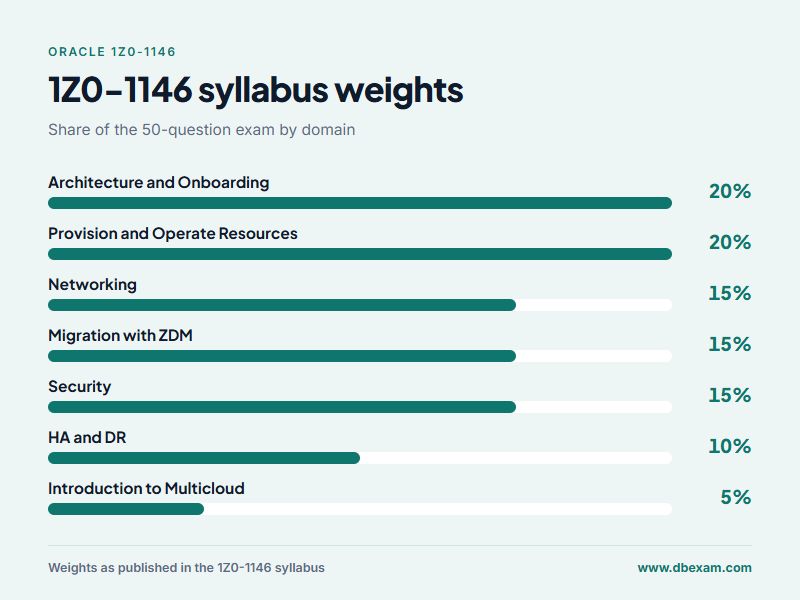
Oracle Database@AWS Architecture and Onboarding and Provision and Operate Oracle Database@AWS Resources are the heaviest 1Z0-1146 domains at 20% each. Networking, migration and security follow at 15% each. HA and DR with Oracle Database@AWS carries 10%, and Introduction to Multicloud carries 5%.
| Domain | Weight | Approximate questions out of 50 |
|---|---|---|
| Introduction to Multicloud | 5% | About 2 or 3 |
| Oracle Database@AWS Architecture and Onboarding | 20% | About 10 |
| Configure Oracle Database@AWS Networking | 15% | About 7 or 8 |
| Provision and operate Oracle Database@AWS Resources | 20% | About 10 |
| Migrate Oracle Databases to Oracle Database@AWS | 15% | About 7 or 8 |
| HA and DR with Oracle Database@AWS | 10% | About 5 |
| Secure Oracle Database@AWS | 15% | About 7 or 8 |
The right-hand column multiplies each published weight across the 50 items. Oracle gives no per-domain question count, so treat those numbers as a planning guide; your own exam form may differ by a question or two.
Introduction to Multicloud (5%)
This short domain asks you to explain what multicloud means, why organisations adopt it, and the common use cases Oracle supports through OCI. Expect a question or two about running the database next to applications that live in another provider, reducing dependence on a single vendor, keeping existing Oracle features without re-platforming, and buying database capacity through the cloud marketplace an organisation already uses.
Oracle Database@AWS Architecture and Onboarding (20%)
Here you must explain the service and its architecture, the Oracle Database services it offers, the prerequisites for onboarding and how procurement works. The services in scope are Exadata Database Service on dedicated infrastructure and Autonomous Database on dedicated Exadata infrastructure. Onboarding links an AWS account to an OCI tenancy, and procurement runs through AWS Marketplace so the database appears on the AWS bill. Questions often test which tasks happen in the AWS console and which in the OCI console.
Configure Oracle Database@AWS Networking (15%)
This domain covers the ODB network design, the network topologies Oracle supports and DNS configuration. An ODB network is a private, isolated network that holds the Exadata resources, with a client subnet for application traffic and a backup subnet. Nothing can reach it until you add connectivity, usually through ODB peering with an Amazon VPC. DNS questions centre on the OCI DNS listening endpoint, the DNS forwarding endpoint, and the client subnet addresses each one consumes.
Provision and operate Oracle Database@AWS Resources (20%)
The operational domain walks the full build: create the ODB network and the ODB peering connection, provision Exadata infrastructure, an Exadata VM cluster and an Autonomous VM cluster, create an Exadata database with its components, create an Autonomous Container Database and an Autonomous Database, then explain backup and restore and configure monitoring and observability. Order matters here. Many wrong answers describe a valid step taken before the resource it depends on exists.
Migrate Oracle Databases to Oracle Database@AWS (15%)
Migration questions are about Oracle Zero Downtime Migration (ZDM). You need to understand what ZDM is, then explain its workflows for two different targets: Exadata Database Service on Oracle Database@AWS and Autonomous Database on Oracle Database@AWS. The distinction between physical and logical migration, and which of them each target accepts, is the core of this domain.
HA and DR with Oracle Database@AWS (10%)
The two objectives are to design high availability and to configure disaster recovery. High availability inside one location comes from the clustered Exadata platform. Disaster recovery adds a standby database, normally with Oracle Data Guard, in another availability zone or another region. Expect questions that ask you to match a recovery requirement to the cheapest design that meets it.
Secure Oracle Database@AWS (15%)
The security domain covers identity and access management, data protection, the security controls built into the service and the OCI well-architected pillars as they apply to Oracle Database@AWS. Typical questions involve who may create or change resources on each side of the partnership, how Transparent Data Encryption keys are held, how client connections are encrypted and which network rules Oracle manages on your behalf.
DBExam's 1Z0-1146 syllabus page lists every objective with these weights, and it works well as a checklist you mark off week by week.
Which 1Z0-1146 domain is hardest for experienced DBAs and cloud engineers?
For most candidates the hardest 1Z0-1146 domain is Configure Oracle Database@AWS Networking. It carries 15%, but its ideas leak into provisioning, security and HA questions as well. ODB networks, ODB peering, client and backup subnets, DNS endpoints and Oracle-managed network security groups behave differently from both plain AWS networking and plain OCI networking, so experience in either cloud alone misleads.
Database administrators usually find the networking questions hardest. A DBA knows listeners, SCAN addresses and service names thoroughly, but may never have planned VPC route tables or a private DNS zone. When a stem says that nothing in the application VPC can reach the listener minutes after the build, the DBA instinct is to look for a database problem. The exam expects you to recognise that an ODB network is private and isolated until connectivity is added on purpose.
AWS engineers hit the opposite trap. They know VPC peering, transit gateways and Route 53 resolver rules, and they assume an ODB network will behave like any other VPC. It does not. ODB peering is its own construct with its own limits, the DNS integration uses endpoints on the OCI side that consume client subnet addresses, and some security rules sit in network security groups that Oracle manages and may re-apply when the network changes. Answers that treat the ODB network as just another VPC are usually the distractors.
The second hardest area for many people is migration. ZDM has several workflows, and the exam asks you to explain them for two targets. Physical migration keeps the database as it is and suits Exadata Database Service, while Autonomous Database targets rely on a logical approach. Candidates who have only ever used Data Pump or only ever built a Data Guard standby tend to choose the method they know rather than the one the target requires.
Architects who already run Oracle Database@Azure or Oracle Database@Google Cloud have an advantage across the board, because the multicloud model is similar. They should still study the AWS-specific names and limits closely, because the exam rewards the exact behaviour of this service rather than a general sense of how Oracle multicloud works.
What real-world scenarios appear on the 1Z0-1146 exam?
The 1Z0-1146 exam frames most questions as architecture scenarios: a regulated company reducing single-provider risk, an application VPC that cannot reach a new VM cluster, a DNS change that breaks name resolution, a migration that must avoid downtime, a recovery target across zones, or a security standard that rules out a connection method. You choose the design that meets every stated constraint.
The worked examples below explain the reasoning behind each scenario type. They are illustrations built from the syllabus objectives, not items from the live exam.
Reducing provider risk without taking on platform work
A company's applications run on AWS and will stay there. Its database team is small and cannot take on hardware, firmware or Exadata platform operations, yet the system of record must keep the Oracle features it uses today. Re-platforming to a different engine removes those features, and running Oracle on EC2 hands the team the platform work it has ruled out. Oracle Database@AWS fits, because Oracle operates the Exadata platform while the application estate and the purchase stay with AWS.
A new VM cluster that nobody can reach
Right after the first build, the application team, the corporate network and an internet test all fail to reach the database. Nothing is broken. An ODB network starts private and isolated, so the architect adds connectivity deliberately, typically an ODB peering connection to the application VPC with matching routes. Holding the incident while waiting for provisioning or blaming an unfinished link between the clouds both misread what the stem describes.
Name resolution in both directions
Applications in a peered VPC must reach the VM cluster by host name, and jobs on the database hosts must resolve names in a private zone attached to that VPC. Two components are needed: an OCI DNS listening endpoint that answers queries arriving from AWS, and a DNS forwarding endpoint that sends queries from the OCI side out to AWS. Each consumes a client subnet address, so they belong in the subnet plan before the ODB network is created.
Hardening that broke DNS
A network team trimmed its VPC-side policy so that only UDP on port 53 remains, and longer lookups now fail at random. DNS falls back to TCP for larger responses, and the ODB network's DNS rules expect port 53 over both TCP and UDP. The fix is to restore TCP on port 53 on the team's own side, not to add a rule to an Oracle-managed security group that a later network update may overwrite.
Encrypting traffic without files in containers
A platform standard forbids wallets or keystores anywhere in a container, and the security policy asks for AES-256 where the client supports it. TCPS needs a wallet, so every option that ships, mounts or downloads one breaks the standard. Oracle native network encryption over TCP negotiates the strongest algorithm both sides support, including AES-256, and needs no wallet, which meets both requirements.
Choosing a migration method by target
A team must move a large on-premises database with minimal downtime. If the target is an Exadata VM cluster, a ZDM physical online workflow can keep a synchronised standby running and switch over in a short window. If the target is an Autonomous Database, the answer changes to a logical ZDM workflow, because Autonomous Database is not the target of a physical copy. Read the target before the method.
Is there an Oracle practice test or question bank for 1Z0-1146?
Oracle's official preparation for 1Z0-1146 is the Become an Oracle AI Database@AWS Architect Professional learning path on Oracle MyLearn, and Oracle offers no public question bank for sale. DBExam's 1Z0-1146 practice test is an independent online exam simulator written against the published syllabus and exam format, and it is separate from Oracle's own material.
Use the two for different jobs. The learning path explains the service: how onboarding works, what an ODB network is, how ZDM moves a database and how Data Guard protects it. A timed practice test tells you whether you can apply those ideas inside 108 seconds per question, against distractors written to catch half-learned details. Reading the course a second time feels productive but rarely shows you a weak domain. A scored attempt does.
Our practice test follows the real exam's properties: 50 multiple-choice questions, a 90-minute limit and a 68% target. Questions are scenario-based, every attempt is timed, and the result history shows your selected and correct answers so you can trace each mistake back to its domain. Access gives unlimited attempts for two months, which covers a six-week plan with time to spare. DBExam also publishes free sample questions for 1Z0-1146, so you can judge the style before you commit.
Avoid anything advertised as real exam questions or dumps. Oracle's certification agreement forbids the use of leaked content, and such collections are often wrong or copied from a different exam. For a new service like Oracle Database@AWS, stale or borrowed material is especially risky, because an answer that is right for Exadata Cloud on another platform may not hold on Oracle Database@AWS.
How should you prepare for 1Z0-1146 in six weeks?
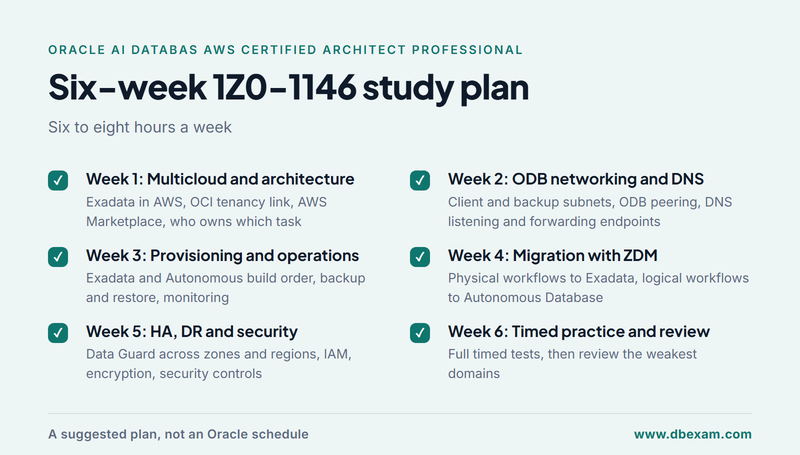
A realistic 1Z0-1146 plan runs over six weeks, with six to eight study hours each week. Cover multicloud and architecture first, then networking and DNS, then provisioning and operations, then migration with ZDM, then HA, DR and security, and spend the final week on timed practice tests and the domains they show you are weakest in.
Week 1: Multicloud and architecture
Read the multicloud objectives, then study how Oracle Database@AWS is built: Exadata infrastructure in an AWS location, operated by Oracle, linked to an OCI tenancy and bought through AWS Marketplace. Write down which tasks belong in the AWS console and which in the OCI console. At the end of the week, sit a timed practice test to record your starting score.
Week 2: ODB networking and DNS
Draw the ODB network, its client and backup subnets, an ODB peering connection and the application VPC. Add the DNS listening endpoint and the forwarding endpoint, and note what each consumes. Then list the rules Oracle manages for you and the rules you control in AWS. This is the week to slow down, because the ideas reappear in three other domains.
Week 3: Provisioning and operations
Follow the build order from ODB network to Exadata infrastructure, VM cluster and database, and separately to the Autonomous VM cluster, Autonomous Container Database and Autonomous Database. Study the backup and restore options and the monitoring available in AWS and in OCI. If you have access to a tenancy, walk through the screens; if not, use the documentation's step lists.
Week 4: Migration with ZDM
Learn what Zero Downtime Migration does and how its workflows differ. Compare a physical migration into Exadata Database Service with a logical migration into Autonomous Database, and note the prerequisites and the downtime each implies. Practise answering one question repeatedly: given this source and this target, which workflow applies?
Week 5: HA, DR and security
Design a highly available deployment, then add a Data Guard standby in another availability zone and another in a second region, and note what each protects against. Then cover identity and access management on both sides, encryption at rest and in transit, the security controls built into the service and the well-architected pillars.
Week 6: Timed practice and review
Sit at least two complete timed practice tests on separate days. Sort every wrong answer by domain and return to the source material for those objectives only. Book the exam when you clear 68% with room to spare twice in a row and can say why every distractor fails.
If you already run Oracle databases on another Oracle multicloud service, you can shorten the plan to four weeks by merging weeks one and three. If AWS networking is new to you, add a week before week two for VPCs, route tables, security groups and private DNS.
Mistakes that cost candidates marks
Treating the ODB network as a VPC. It is a separate, private construct with its own peering rules and DNS endpoints. Answers that reach for ordinary VPC peering or Route 53 records alone are usually wrong.
Editing Oracle-managed rules. Several distractors fix a problem by changing a network security group Oracle manages. Such changes may be reverted when the network is next modified, so the exam prefers a fix on the side you own.
Choosing a migration method before reading the target. Exadata and Autonomous Database targets accept different ZDM workflows. Decide the target first and the method follows.
Ignoring who operates what. Oracle runs the Exadata platform, AWS hosts it and bills for it, and you run the databases and applications. Many questions turn on that division.
Rushing choose-two items. Judge each option on its own merits. The second correct answer is often the less obvious detail.
What happens after you pass, and where is your score report?
Your 1Z0-1146 result appears in Oracle CertView, the certification account linked from Oracle MyLearn. When you pass, Oracle records the Oracle AI Databas AWS Certified Architect Professional credential against your profile and issues a shareable digital badge for your CV and online profiles.
The score report states whether you passed and can point to the topic areas where you lost marks. If the first attempt falls short, those areas are your study list for the second attempt. Revisit them before anything else, take a fresh timed practice test, and read the retake rules on MyLearn before booking a new date.
The credential tells an employer that you can carry an Oracle database estate into AWS without losing the features, performance or protection the business relies on: you can plan the network, choose the migration path, design recovery and secure the result. That combination of Oracle and AWS skills is still uncommon, and it is exactly what this exam measures.
Oracle Database@AWS keeps adding regions and features, so keep the product documentation close after the exam as well as before it. The Oracle Database@AWS documentation is the reference to check whenever a design decision depends on current behaviour.
FAQs
How long is the 1Z0-1146 exam and how many questions does it contain?
You get 90 minutes to answer 50 multiple-choice questions on 1Z0-1146, roughly 108 seconds each. Because many stems describe a network, a team and a policy before the question itself, timed practice matters as much as knowledge. Reading the last line of a stem first saves time.
What is the 1Z0-1146 passing score?
The passing mark for 1Z0-1146 is 68%. On a 50-question form that means 34 correct answers, leaving room for 16 mistakes. Two domains weigh 20% apiece, so weakness in architecture or in provisioning can use up that margin quickly.
How much is the 1Z0-1146 exam fee?
Oracle prices 1Z0-1146 at USD 245 as of October 2026. The amount can differ by country or local currency, and tax may be added. Check the figure in your MyLearn account at booking time, along with the rules for rescheduling and retakes.
Which certification does passing 1Z0-1146 give you?
A pass on 1Z0-1146 awards the Oracle AI Databas AWS Certified Architect Professional credential, which Oracle files under Oracle Cloud Infrastructure. It is meant for architects and database administrators responsible for Oracle Exadata and Autonomous Database workloads hosted in AWS.
How is the 1Z0-1146 syllabus weighted?
Seven domains make up the 1Z0-1146 syllabus. Architecture and onboarding and provisioning carry 20% apiece; networking, ZDM migration and security take 15% each high availability and disaster recovery has 10%; and the multicloud introduction is worth 5%.
Can you buy an Oracle question bank for 1Z0-1146?
Oracle sells no public question bank for 1Z0-1146 its preparation route is a MyLearn learning path for Oracle AI Database@AWS architects. DBExam's 1Z0-1146 practice test is a separate, independent timed simulator that follows the published syllabus and exam format, not an Oracle product.
- Oracle Cloud Infrastructure |
- 1Z0-1146 |
- Oracle 1Z0-1146 Questions and Answers |
- Oracle AI Databas AWS Certified Architect Professional |
- 1Z0-1146 Study Guide |
- 1Z0-1146 Practice Test |
- Oracle AI Database AWS Architect Professional Certification Questions |
- 1Z0-1146 Sample Questions |
- 1Z0-1146 Simulator |
- Oracle AI Database AWS Architect Professional Online Exam |
- Oracle AI Database AWS Architect Professional |
- 1Z0-1146 Certification |
- AI Database AWS Architect Professional Exam Questions |
- AI Database AWS Architect Professional |
- 1Z0-1146 Study Guide PDF |
- 1Z0-1146 Online Practice Test |
- Oracle AI Database@AWS Mock Test |
- 1Z0-1146 Test Questions |
- 1Z0-1146 Exam Guide |
- 1Z0-1146 Study Material |
- 1Z0-1146 Syllabus |
- Oracle AI Database AWS Architect Professional Syllabus |
- Oracle AI Database AWS Architect Professional Prep Guide |
- 1Z0-1146 Certification Exam Cost


