
How to Progress Through Oracle Eloqua Marketing Certification Levels in 2026
Oracle 1Z0-340-26 is the Professional-level implementation exam on the Oracle Eloqua certification path, and the one to aim for once you can run campaigns in Eloqua and want to be trusted to set the platform up: 50 multiple-choice questions, 90 minutes, a 68% pass line and a price of USD 245 as of November 2026, leading to the Oracle Eloqua Marketing 2026 Implementation Professional credential.
This guide is written to point you in the right direction rather than to sell you on the exam. It shows where 1Z0-340-26 sits among Oracle's marketing and CX credentials, which route into it suits a marketer, an administrator or a consultant, what the six syllabus areas demand, and what to do after you pass. If you already work in Eloqua daily, take the 1Z0-340-26 practice test first; your score will tell you which level of this pathway you are really standing on.
Where does 1Z0-340-26 sit on the Oracle Eloqua certification path?
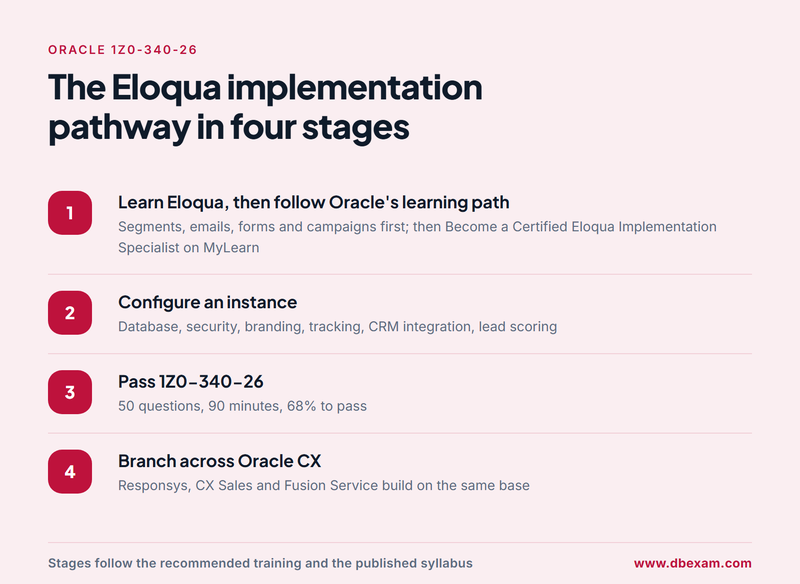
1Z0-340-26 sits at the Implementation Professional level of Oracle's Eloqua pathway: above everyday platform use, which Oracle teaches through its Eloqua user training, and below the broader Oracle CX consultant profile that adds Responsys, CX Sales and Fusion Service credentials. There is no earlier exam named in the published exam details; the entry route is the recommended learning path, Become a Certified Eloqua Implementation Specialist, on Oracle MyLearn.
Read the pathway as three levels. Level one is competence as a user: you can build a segment, lay out a responsive email, publish a landing page with a form and run a campaign on the Campaign Canvas. Oracle does not certify this level with an exam for Eloqua, but nothing on 1Z0-340-26 makes sense without it. Level two is this exam: you can stand up a new Eloqua instance, model its data, secure it, connect it to a CRM, switch on lead scoring and the newer AI and Redwood capabilities, and hand it over working. Level three is breadth: the Oracle CX family continues with Responsys (1Z0-1032-26), CX Sales (1Z0-1061-26) and Fusion Service (1Z0-1064-26) implementation exams, each of which assumes the discipline 1Z0-340-26 proves.
The year in the code matters for your planning. Oracle reissues this exam with a new suffix as the product moves, and the 2026 edition is the first to put AI, machine learning, mobile and automation features and the Redwood experience on the syllabus as their own sections. If you hold an earlier Eloqua implementation credential, treat 1Z0-340-26 as the version that brings you current rather than a repeat of what you already passed.
The exam belongs to the Oracle CX category and is tied to Oracle Eloqua Marketing Cloud Service. The Oracle 1Z0-340-26 exam page is where the current fee, the learning path and the booking link live, and it is the page to check before you commit to a date.
Which route into 1Z0-340-26 fits your background?
There are three realistic routes into 1Z0-340-26, and the right one depends on what you already do: marketers should start from the data model and work outward to integration, Eloqua administrators should start from integration and extensions and work back to campaign craft, and consultants from other marketing platforms should start from Oracle's implementation methodology before touching any feature.
If you are a marketer who uses Eloqua every day
You already own level one. Your gap is everything that happened before your login was created: database setup, security groups, email groups and preference management, branding and deliverability, tracking scripts and the first forms. Spend your early weeks there, then move to CRM integration and lead scoring, which marketers often see only from the reporting side. Do not spend study time on the Email Editor or the Campaign Canvas until you have confirmed, with a timed practice test, that those sections are already safe.
If you are an Eloqua administrator or marketing operations lead
You probably understand the integration wizard, data priority and lead scoring better than most consultants. Your risk is the opposite one: questions about implementation milestones, prerequisite documents and the people a project needs, which you may never have had to think about, plus the campaign-level details you delegate to colleagues. Read the Getting Started objectives first, then rebuild one full campaign and one program from scratch yourself.
If you are a consultant arriving from another platform
You know how a marketing automation implementation runs, so the Getting Started section will feel familiar and the vocabulary will not. Give yourself a dedicated sprint on Eloqua's own terms: segments and shared filters, contacts and custom objects, form processing steps, the Campaign Canvas versus the Program Canvas, field merges versus dynamic content versus cloud content. Then work through the extensions. Your methodology experience will carry the scenario questions once the words stop getting in the way.
If you are a developer or integration specialist
Treat this as a configuration exam, not a coding exam. Nothing on the syllabus asks you to write against the API. Your advantage is understanding of CRM data flow and closed-loop reporting; your gap is the marketer's craft. Pair with a campaign manager, or build the marketing assets yourself in a sandbox, before you book.
What does the 1Z0-340-26 exam require: format, pass mark and fee?
1Z0-340-26 asks 50 multiple-choice questions, allows 90 minutes, and sets the pass line at 68%, which is 34 correct answers. Oracle prices it at USD 245 as of November 2026, with the usual note that pricing can vary by country or local currency. It is filed under Oracle CX and versioned to Oracle Eloqua Marketing Cloud Service.
| Detail | 1Z0-340-26 |
|---|---|
| Exam | Oracle Eloqua Marketing 2026 Implementation Professional |
| Credential | Oracle Eloqua Marketing 2026 Implementation Professional |
| Items on the paper | 50, multiple choice |
| Clock | 90 minutes |
| Pass line | 68% |
| Price | USD 245 in November 2026; local pricing applies |
| Track | Oracle CX, Oracle Eloqua Marketing Cloud Service |
Plan your attempt around the sections rather than the margin. The syllabus has six areas with no published percentage weights, and the two newest, AI and automation features and Redwood, are short enough to read in an evening yet can still cost marks if ignored. Sixteen wrong answers sounds like room; spread across six areas it is not.
Many items ask you to choose two options. Eloqua scenario questions use this format to pair a configuration with its consequence, for example which two form processing steps both write submitted values to the contact and enrol the submitter in a program. Evaluate each option on its own against the scenario; the two correct ones rarely resemble each other.
The clock is comfortable at just under two minutes per item, provided you read for the operative detail. Phrases such as the most likely durable cause, up-to-the-minute pricing or reuse the same criteria in several segments are the hinge of the question. Identify the hinge, then look at the options.
Expect questions written as diagnostics as often as questions written as tasks. A form that updates the contact but never emails the account manager, a Campaign Canvas where contacts stall at a cloud action, a marketing-influence report with no attributed revenue: each describes a symptom and asks for the cause, and the cause is always a specific configuration you either made or missed.
What do the six 1Z0-340-26 syllabus areas cover, and in what order should you learn them?
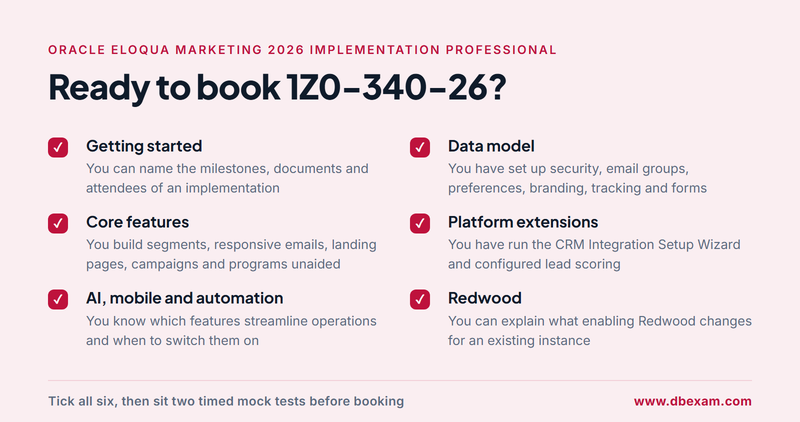
The six 1Z0-340-26 syllabus areas are Getting Started with Eloqua, Understanding the Eloqua Data Model, Configuring Core Features, Configuring Platform Extensions, Leveraging AI, ML, Mobile and Automation Features, and Enabling Redwood Capabilities. Learn them in that order if you are new to implementation, because each one assumes the previous; experienced users should start with the data model and extensions and return to the first and last sections before the exam.
1. Getting Started with Eloqua
This section covers the implementation itself: the major milestones and key deliverables of Oracle's implementation offerings, the prerequisite documents a project needs, and the attendees who must be in the room. Discovery and requirements workshops belong here, where the goals are documenting the client's data model, contact fields and custom objects and defining the CRM integration scope, not tuning lead scores or publishing campaigns.
2. Understanding the Eloqua Data Model
Here you set up the database: security settings, database administration tasks, email groups, preference management, the branding and deliverability tasks that protect sending reputation, tracking implementation and the first forms. This is the section marketers most often underestimate, because by the time they arrive it has already been done.
3. Configuring Core Features
The longest section by objectives: navigating Eloqua, the Segment Editor, responsive design in the Email Editor and the Landing Page Editor, data collection in the Form Editor, the Campaign Canvas, Eloqua reports and programs on the Program Canvas. Form processing steps, shared filters versus shared lists, and the difference between the two canvases are examined here through scenarios.
4. Configuring Platform Extensions
Two halves. First, CRM integration: understanding and exploring it, prioritising data between systems and using the CRM Integration Setup Wizard. Second, extending Eloqua: lead scoring, sales tools, Advanced Intelligence, the Oracle App Cloud and closed-loop reporting. If attributed revenue is missing from a marketing-influence report, the answer lives in this section, usually in how CRM opportunities link to contacts who were campaign members.
5. Leveraging AI, ML, Mobile and Automation Features
A single, broad objective: use AI, machine learning, mobile and other automation features to streamline processes and drive operational efficiency. Know which capabilities exist, what each one automates and what an implementer must configure before a client can rely on it.
6. Enabling Redwood Capabilities
Also a single objective: enable the Redwood capabilities and understand their implications for existing configurations. The durable idea is that Redwood is a modernised user experience layered over Eloqua's existing functionality and data, not a new data model, a new integration method or a separately purchased app.
DBExam 1Z0-340-26 syllabus page carries every objective under these six headings, and it is the list to work down as you move through the levels.
Which 1Z0-340-26 topics decide pass or fail for most candidates?
Five topic clusters decide most 1Z0-340-26 results: form processing steps, the three personalisation mechanisms, shared filters versus shared lists, CRM integration and closed-loop reporting, and the behaviour of lead scoring models. Each appears repeatedly in the published sample questions, and each has a precise answer that a confident user often gets slightly wrong.
Form processing steps. Update Contacts writes submitted values to the contact record. Add to Program enrols the submitter in a program. Send Notification Email tells an internal recipient; if the account manager never hears about a submission, that step is missing from the sequence. Redirect to Web Page only moves the browser. Learn the steps as verbs and the diagnostics become obvious.
Field merge, dynamic content and cloud content. A field merge inserts a stored contact-field value. Dynamic content swaps predefined blocks based on stored field values. Cloud content pulls a block from an external app when the message renders, which is the only one of the three that can show live pricing from another system. Candidates who treat these as synonyms lose a cluster of marks.
Shared filters versus shared lists. A shared filter stores reusable criteria that many segments can reference. A shared list stores a fixed set of contacts explicitly added as static members. When the scenario says save criteria once and reuse them, the answer is the filter.
CRM integration and closed-loop reporting. Revenue appears in Eloqua's marketing-influence reporting only when CRM opportunities are linked to contacts who were members of Eloqua campaigns. Build order on a project matters too: discovery defines the integration scope, the wizard sets it up, data priority resolves conflicts, and closed-loop reporting proves the result.
Lead scoring models. More than one scoring model can run at once. When a client is ready for a second model for a new line of business, you activate it and use both scores; you do not pause integration or deactivate the first. A scoring model combines a profile dimension with an engagement dimension, and that structure is examined directly.
Cloud actions and apps. When contacts pile up at a cloud action on the Campaign Canvas while the segment feeds normally, the durable cause is the app itself: invalid credentials or configuration, so the external service is not accepting the contacts. Learn to separate canvas behaviour from app behaviour.
Across all six, the exam is asking the same question in different clothes: do you know which Eloqua object or step produces the behaviour described? If you can answer that for each cluster without hesitation, you are at the level the credential certifies.
Should you rely on Oracle's training or a practice test for 1Z0-340-26?
Use both, in sequence: Oracle's Become a Certified Eloqua Implementation Specialist learning path on MyLearn teaches the implementation, and a timed practice test shows whether you can apply it under exam conditions. Oracle does not publish a question bank for 1Z0-340-26. The DBExam 1Z0-340-26 practice test is a separate, independently written simulator that follows the published syllabus and question style; it is not Oracle content and does not claim to be.
Think of the learning path as the route and the simulator as the map check. The path walks you through setting up an instance in the order a project would. The simulator tells you, section by section, where you would currently lose marks, which is information no course can give you about yourself. Candidates who skip the second step tend to discover their weak section on exam day, which is the most expensive place to find it.
The DBExam bank holds more than 270 scenario questions for this exam and serves a timed full-length test shaped like the real one, with every attempt recorded so you can compare the option you chose with the correct one and watch your section scores move over two months of unlimited attempts. A free page of 1Z0-340-26 sample questions on DBExam shows the style before you decide.
Steer clear of anything sold as actual exam questions. It breaks Oracle's candidate agreement, it is usually written for an earlier edition of a yearly versioned exam, and it trains recognition instead of reasoning. The 2026 syllabus added AI, automation and Redwood sections precisely to catch candidates relying on old material.
How should you sequence a six-week 1Z0-340-26 preparation plan?
Sequence 1Z0-340-26 preparation the way an implementation runs: project foundations and the data model in weeks one and two, core features in week three, integration and extensions in week four, the AI, automation and Redwood sections in week five, and two timed mock tests with targeted review in week six. Six to seven hours a week is enough if most of it is spent configuring, not reading.
Week 1: Foundations and the database
Read the Getting Started objectives and write down the milestones, documents and attendees of an implementation in your own words. Then set up a sandbox database: security settings, administrative tasks, email groups and preference management. Sit a baseline timed practice test at the end of the week.
Week 2: Branding, deliverability, tracking and forms
Complete the branding and deliverability tasks, implement tracking on a test page and build your first forms with each processing step in turn. Break a form on purpose by removing a step and note the symptom, because the exam describes symptoms.
Week 3: Core features end to end
Build a segment with a shared filter and a shared list, a responsive email using a field merge, dynamic content and cloud content, a landing page with a form, a campaign on the Campaign Canvas and a program on the Program Canvas. Open the reports for each and learn what they show.
Week 4: Integration and extensions
Work through the CRM Integration Setup Wizard, set data priority, configure a lead scoring model and then activate a second one. Review sales tools, Advanced Intelligence and the Oracle App Cloud, and trace how a closed-won opportunity becomes attributed revenue in closed-loop reporting.
Week 5: AI, automation and Redwood
Enable the AI, machine learning, mobile and automation features available in your instance and record what each one changes for an operator. Enable Redwood in a sandbox and compare the experience with the classic interface, noting what stays the same underneath.
Week 6: Mock tests and review
Take two full timed mock tests on different days, sort every miss by syllabus area and go back to the sandbox only for those areas. Book the exam when both scores sit comfortably above 68%.
Advice that saves the most time
Start where your route says, not at page one. A marketer who spends week one on the Email Editor has spent it on the section they already own.
Learn form steps and personalisation types as a table. Two short tables cover a disproportionate share of the exam.
Do not postpone the two short sections. AI and automation and Redwood are quick to prepare and easy to lose.
Practise diagnosis. For every feature you configure, ask what the symptom would be if it were missing.
What comes after 1Z0-340-26 on the Oracle CX pathway?
After 1Z0-340-26 your result is posted in CertView, Oracle's certification portal, under the account you booked with, and the Oracle Eloqua Marketing 2026 Implementation Professional credential appears on your record together with a digital badge you can share. The sensible next steps are to deepen within Eloqua on a live implementation, to widen into a neighbouring Oracle CX credential, and to plan for the next year-suffixed edition of this exam.
If the attempt falls short, the report identifies the areas where you answered incorrectly. Return to the sandbox for those areas only, sit one more timed mock, confirm the retake rules on MyLearn, then rebook. A second attempt with a plan behind it is a normal part of this pathway, not a detour from it.
Widening is where the credential pays off fastest. The Responsys Marketing Platform 2026 Implementation Professional exam (1Z0-1032-26) covers Oracle's other marketing automation platform and suits agencies that serve both B2B and B2C clients. The CX Sales 2026 Implementation Professional exam (1Z0-1061-26) sits on the other side of the CRM integration you configured for Eloqua. The Fusion Service 2026 Implementation Professional exam (1Z0-1064-26) completes the marketing, sales and service triangle. Each is a Professional-level implementation exam of the same shape, so the study habits you built for 1Z0-340-26 transfer directly.
Finally, keep the credential current. Oracle brings out a new edition of this exam whenever Eloqua has moved far enough, and the 2026 edition's new sections show how quickly that can happen. Bookmark the Oracle Eloqua documentation, read the release notes as they land, and plan to sit the next edition while the previous one is still fresh. That habit is what separates a certified implementer from a current one.
FAQs
What level is the 1Z0-340-26 certification?
1Z0-340-26 is a Professional-level implementation exam in the Oracle CX track. It sits above everyday Eloqua platform use, which Oracle teaches but does not examine, and leads to the Oracle Eloqua Marketing 2026 Implementation Professional credential. No earlier exam is named as a prerequisite in the published exam details.
Is there a prerequisite for the 1Z0-340-26 exam?
The published details for 1Z0-340-26 name recommended training rather than a prerequisite exam: Oracle's Become a Certified Eloqua Implementation Specialist learning path on MyLearn. Hands-on experience configuring an Eloqua instance, including the data model and CRM integration, is the practical prerequisite most candidates need.
How many questions are on 1Z0-340-26 and how long is it?
1Z0-340-26 has 50 multiple-choice questions and a 90-minute time limit. Several items ask for two correct options, typically pairing a configuration with its consequence, so judge each option against the scenario on its own rather than looking for two answers that sound alike.
What score passes 1Z0-340-26?
A score of 68% passes 1Z0-340-26, so 34 of the 50 items must be right. The six syllabus areas carry no published weights, so prepare all of them, including the two short sections on AI and automation features and on Redwood, which are quick to study and costly to skip.
How much does 1Z0-340-26 cost and where do you book it?
1Z0-340-26 costs USD 245 as of November 2026, and Oracle notes that the amount may vary by country or local currency. You book it through the exam's page on Oracle MyLearn, which also shows the recommended learning path and the current retake conditions.
Which certification should you take after 1Z0-340-26?
Stay inside the Oracle CX family: 1Z0-1032-26 for Responsys, Oracle's other marketing automation platform; 1Z0-1061-26 for CX Sales, on the far side of the CRM integration you configured; or 1Z0-1064-26 for Fusion Service. All three are Professional-level implementation exams with the same 50-question, 90-minute shape.
- Oracle Eloqua Marketing Implementation Professional Certification Questions |
- Oracle Eloqua Marketing Implementation Professional Online Exam |
- Oracle Eloqua Marketing Implementation Professional Prep Guide |
- Eloqua Marketing Implementation Professional Exam Questions |
- Eloqua Marketing Implementation Professional |
- Oracle Eloqua Marketing Cloud Service Mock Test |
- Oracle CX |
- 1Z0-340-26 |
- Oracle 1Z0-340-26 Questions and Answers |
- Oracle Eloqua Marketing 2026 Implementation Professional |
- 1Z0-340-26 Study Guide |
- 1Z0-340-26 Practice Test |
- 1Z0-340-26 Sample Questions |
- 1Z0-340-26 Simulator |
- 1Z0-340-26 Certification |
- 1Z0-340-26 Study Guide PDF |
- 1Z0-340-26 Online Practice Test |
- 1Z0-340-26 Test Questions |
- 1Z0-340-26 Exam Guide |
- 1Z0-340-26 Study Material |
- 1Z0-340-26 Syllabus |
- Oracle Eloqua Marketing 2026 Implementation Professional Syllabus |
- 1Z0-340-26 Certification Exam Cost


