
Oracle 1Z0-1158-26 Practice Test and Syllabus for OCI Enterprise AI
The Oracle 1Z0-1158-26 exam, Oracle Cloud Infrastructure Enterprise AI Professional, leads to the Oracle Cloud Infrastructure Certified Enterprise AI Professional credential. It has 50 multiple-choice questions, lasts 90 minutes, needs a 68% passing score and costs USD 245 as of October 2026. Its largest domain, building OCI Enterprise AI Agents, carries 25%.
This is a 2026 exam built around agents rather than chatbots, so experience with earlier OCI generative AI services helps but does not cover it. Questions move from LLM theory to the Responses API, MCP tool calling, agent memory, hosted container agents and guardrails. The quickest way to see which of those you can already handle under time pressure is to start the 1Z0-1158-26 practice test in your first week, then let the results decide where your study hours go.
What does the 1Z0-1158-26 exam test?
The 1Z0-1158-26 exam tests whether you can design, build, deploy and govern AI agents on Oracle Cloud Infrastructure. Its syllabus has seven sections. Two cover the theory every agent depends on, large language models and agentic AI. Three cover OCI Enterprise AI itself: models, agents and hosted agents. One covers governance and cost, and one introduces the platform's capabilities.
Read the verbs in the syllabus and the level of the exam becomes clear. Oracle does not ask you to "list" or "define" much. It asks you to evaluate architectures, select tools, compare memory types, determine cluster sizing, configure hyperparameters and deploy containers. Those are decisions, and decision questions are written as short scenarios: a business requirement, a constraint, and four options that are all technically possible but only one of which fits.
That has a practical consequence for how you learn each topic. Knowing that OCI Agent Memory offers short-term memory, long-term memory and short-term memory compaction will get you nowhere near the right answer on its own. You need to know which one a long customer-support conversation needs, which one remembers a user's preferences next month, and what compaction trades away to keep a conversation inside a context window.
The exam is written for people who will be accountable for an enterprise AI system once it is in production: AI and machine learning engineers moving onto OCI, cloud architects who are being asked to add agents to existing applications, developers who already call LLM APIs and now need to run them under enterprise security, and technical consultants who design these solutions for clients. Oracle positions the credential at professional level, so it assumes you are comfortable with OCI basics such as compartments, policies and networking.
Oracle's recommended preparation is the learning path "Become an OCI Enterprise AI Professional" on Oracle MyLearn, listed on the Oracle 1Z0-1158-26 exam page. That page is also where you schedule the exam and confirm current details, which matters for a product area that Oracle is still expanding.
How is the 1Z0-1158-26 exam structured, scored and priced?
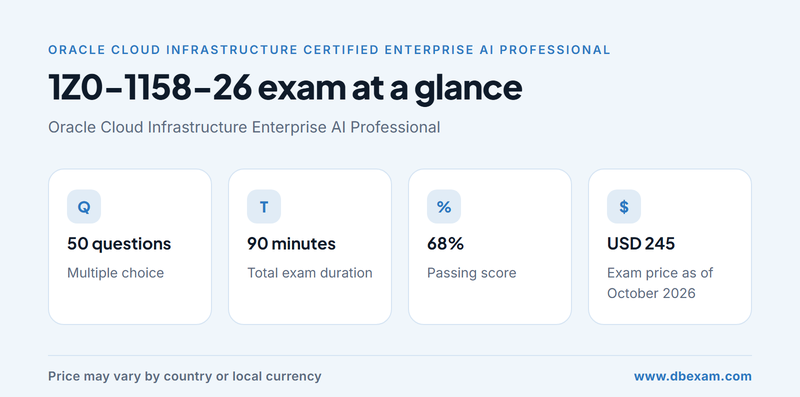
The 1Z0-1158-26 exam contains 50 multiple-choice questions to be answered in 90 minutes, and you need 68% to pass. The exam fee is USD 245 as of October 2026, although Oracle notes that pricing may vary by country or local currency. You register for the exam through Oracle MyLearn, which also lists the delivery options available in your country.
| Item | Detail |
|---|---|
| Exam code | 1Z0-1158-26 |
| Exam name | Oracle Cloud Infrastructure Enterprise AI Professional |
| Certification | Oracle Cloud Infrastructure Certified Enterprise AI Professional |
| Number of questions | 50 |
| Duration | 90 minutes |
| Passing score | 68% |
| Price | USD 245 (as of October 2026; may vary by country) |
Ninety minutes for fifty questions gives you one minute and forty-eight seconds per question. That is more generous than many Oracle exams, but the time disappears quickly on scenario questions where you must read a requirement, eliminate two options that solve a different problem and then choose between two that look close. A sensible pace is to finish a first pass in about 65 minutes, flag anything you are unsure of, and spend the remaining time on the flagged items.
A 68% passing score means you need 34 correct answers out of 50. Put the other way, you can afford to miss 16. That margin sounds comfortable until you look at the weightings: the agent-building domain alone is a quarter of the exam, so a weak area there can consume most of your margin before the other six sections are counted.
The exam is multiple choice, and some items may ask for more than one answer. Read every stem for the words "choose two" or "select all that apply". On a professional-level Oracle exam, a question that asks for two answers usually has one obvious correct choice and one that you will only find if you know the second-order behaviour of the service.
The exam belongs to the Oracle Cloud Infrastructure 2026 certification track. Oracle releases versions of its OCI exams by year, and the "-26" suffix marks this one as the 2026 edition. If you see older study material that refers to a different OCI generative AI exam, treat it as background reading at best, because this syllabus introduces the Responses API, hosted agents and agent memory, which earlier exams did not cover in this form.
How much weight does each 1Z0-1158-26 syllabus domain carry?
Building OCI Enterprise AI Agents is the heaviest domain at 25%, followed by Applying Agentic AI Concepts and Configuring OCI Enterprise AI Models at 20% each. Building and Deploying Hosted Agents is 15%, while Applying Large Language Model Concepts and Governing and Optimizing OCI Enterprise AI are 10% each. The introductory capabilities section carries no stated weighting.
| Syllabus domain | Weight | Approximate questions out of 50 |
|---|---|---|
| Describing OCI Enterprise AI Capabilities | No stated weighting | Underpins the rest |
| Applying Large Language Model Concepts | 10% | About 5 |
| Applying Agentic AI Concepts | 20% | About 10 |
| Configuring OCI Enterprise AI Models | 20% | About 10 |
| Building OCI Enterprise AI Agents | 25% | About 12 or 13 |
| Building and Deploying Hosted Agents | 15% | About 7 or 8 |
| Governing and Optimizing OCI Enterprise AI | 10% | About 5 |
The question counts in the third column are estimates made by applying each weighting to 50 questions. Oracle does not publish a per-domain count, and the real number on your exam form may differ by one or two.
Describing OCI Enterprise AI Capabilities
This section asks you to explain how OCI Enterprise AI supports enterprise solutions through three pillars: Enterprise AI Models, Enterprise AI Agents and Governance. It carries no weighting of its own, but it is the map for everything else. If you can say which pillar a feature belongs to, you can usually rule out at least one option on a scenario question that mixes model, agent and governance features.
Applying Large Language Model Concepts (10%)
This domain covers how LLMs tokenise input and generate output, the difference between encoder-only, decoder-only and encoder-decoder architectures, advanced prompt design for domain-specific tasks, the choice between fine-tuning techniques, and the capabilities of code models, multimodal models and language agents. Expect questions that give you a use case, such as classifying support tickets, generating free text or translating documents, and ask which architecture fits. Encoder-only models suit understanding and embedding tasks, decoder-only models suit open-ended generation, and encoder-decoder models suit tasks that transform one sequence into another.
Applying Agentic AI Concepts (20%)
Here the exam moves from models to agents. You must tell an agent apart from a chatbot or a fixed workflow on three properties: autonomy, reasoning and tool use. You must analyse the agent loop, described in the syllabus as perceive, reason, act and observe, and explain how tools extend what an agent can do. The domain also covers how the Model Context Protocol (MCP) standardises connections between agents, tools and data sources, the difference between short-term and long-term memory, and building a working agent with the Responses API.
Configuring OCI Enterprise AI Models (20%)
This is the most operational domain. It asks you to evaluate model capabilities, classify the pretrained foundation model families by use case, compare ways of customising LLMs with enterprise data, configure fine-tuning and inference by choosing hyperparameters, and work out dedicated AI cluster sizing, unit shapes, pricing options and endpoint configuration. The cluster-sizing objective is where candidates without hands-on time lose marks, because the right answer depends on whether a cluster is for fine-tuning or for hosting, and on the model being served.
Building OCI Enterprise AI Agents (25%)
The largest domain covers OCI Enterprise AI Agents for development, orchestration and execution; the design of the OCI Responses API and its OpenAI compatibility; the built-in tools Code Interpreter, File Search, MCP Calling and Function tools; Remote MCP Calling; OCI Agent Memory with short-term memory, long-term memory and short-term memory compaction; and the OCI Vector Stores API and Files API for grounding responses in enterprise content.
Building and Deploying Hosted Agents (15%)
Hosted agents in OCI Enterprise AI Applications provide a managed runtime for containerised agent workloads. The two objectives ask you to explain that runtime and to deploy an agent by packaging it as a container image and following the OCI hosted agent deployment workflow. This is the domain where general container knowledge pays off most directly.
Governing and Optimizing OCI Enterprise AI (10%)
The final domain covers secure access controls for OCI Enterprise AI resources, how customer data is protected at rest and in transit, guardrails for content moderation, prompt-injection defence and handling of personally identifiable information, and observability and cost management for agents in production.
The full objective list, with the same weightings, is on DBExam's 1Z0-1158-26 syllabus page, which is worth printing and ticking off as you go.
Which domain is hardest for candidates from a technical background?
For most technically experienced candidates, the hardest domain is Building OCI Enterprise AI Agents. It carries the most weight at 25%, and its objectives depend on OCI-specific behaviour: which built-in tool fits a task, how Remote MCP Calling connects an agent to tools, and how the three types of OCI Agent Memory differ. General AI knowledge does not answer those questions.
The difficulty is not that the ideas are unusual. A developer who has built agents with any framework understands tool calling, retrieval and conversation history. The trouble is that the exam asks about OCI's own primitives and their boundaries. A question may describe an agent that has to analyse an uploaded spreadsheet and produce a chart, and offer File Search, Code Interpreter, a Function tool and an MCP call. Someone who thinks in general terms might reach for a custom function. The OCI answer is the built-in tool designed for executing code against data.
Memory is the second trap in the same domain. Short-term memory holds the context of the current conversation. Long-term memory persists information across sessions so that an agent can recall a user's earlier choices. Short-term memory compaction reduces the size of a long conversation's history so it continues to fit, at the cost of keeping a condensed version rather than every turn. Questions tend to describe the symptom, such as an agent that loses track in very long sessions or forgets a customer between visits, and ask which memory feature solves it.
Candidates who come from data science rather than software engineering often find a different domain hardest: Configuring OCI Enterprise AI Models. Hyperparameter choices for fine-tuning feel familiar, but dedicated AI cluster sizing, unit shapes, pricing options and endpoint configuration are cloud-operations questions. If you have never provisioned a cluster for hosting a model, spend lab time on it, because the syllabus gives this domain 20% of the exam.
Cloud architects with deep OCI experience usually find the reverse. Access control, encryption and cost management come naturally, but the LLM and agentic theory domains, together worth 30%, contain distinctions such as encoder versus decoder architectures or agents versus workflows that they have not needed to articulate before. A week of focused reading on those two domains tends to close the gap.
What real-world scenarios show up on the 1Z0-1158-26 exam?
The 1Z0-1158-26 exam frames many questions as enterprise scenarios: a support agent that must answer from internal documents, an analyst assistant that runs code on uploaded data, an agent that needs an external system through MCP, a fine-tuning job that must be sized, or a deployment that must block personal data from reaching a model. Each asks you to choose the OCI feature that meets the stated requirement.
The examples below are written to show the reasoning these scenarios reward. They are illustrations of the syllabus objectives, not questions taken from the exam.
Grounding an agent in company policy documents
A human-resources team wants an agent that answers employee questions using the current policy handbook and nothing else. The relevant objectives are the OCI Files API and Vector Stores API together with the File Search tool. The reasoning runs: upload the documents through the Files API, index them into a vector store, and give the agent File Search so that it retrieves relevant passages before answering. Fine-tuning is the tempting wrong answer. It changes how a model writes, not what it can look up, and it would need retraining every time a policy changes.
Analysing an uploaded spreadsheet
A finance user uploads a quarterly sales file and asks the agent which region grew fastest and to plot the trend. The task needs calculation, not retrieval. Code Interpreter is the built-in tool designed for running code against data, so it is the fit. File Search would find text in the file but would not compute growth rates reliably, which is exactly the distinction the exam is testing.
Connecting an agent to an existing ticketing system
An IT team already exposes its ticketing system through an MCP server and wants an OCI agent to create and update tickets. The objective here is Remote MCP Calling, which lets an agent use tools hosted on an external MCP server. A Function tool could also reach the system, but it would mean writing and maintaining a separate integration, whereas MCP standardises the connection the team has already built.
Keeping a long support conversation on track
A customer-service agent handles troubleshooting sessions that run for dozens of turns, and late in those sessions it begins to lose the earlier details. The symptom points to the context window filling up, so short-term memory compaction is the relevant feature. If the requirement instead were to remember a customer's product and previous fault the next time they return, the answer would be long-term memory.
Choosing between fine-tuning and prompting
A legal team wants responses in its house style and with its preferred terminology. Before reaching for fine-tuning, the syllabus expects you to consider advanced prompt design, which costs nothing to change. Fine-tuning becomes the right answer when the requirement is consistent behaviour across many tasks that prompting cannot reliably deliver, and when the team accepts the cost of a dedicated AI cluster for training and hosting.
Protecting personal data in prompts
A healthcare provider wants to stop patient identifiers from being sent to a model or returned in responses, and to block attempts to override the agent's instructions. Both requirements belong to the governance domain: guardrails for personally identifiable information handling and for prompt-injection defence. Access control alone would not help, because the user is authorised to use the agent; the risk is in what the prompt contains.
Does Oracle offer an official practice test or question bank for 1Z0-1158-26?
Oracle's official preparation for 1Z0-1158-26 is the "Become an OCI Enterprise AI Professional" learning path on Oracle MyLearn; check the exam page for any practice exam Oracle includes with its subscriptions. Oracle does not sell a public question bank. DBExam's 1Z0-1158-26 practice test is an independent, timed exam simulator built on the same syllabus and format; it is not Oracle material.
The two serve different purposes, and most successful candidates use both. The learning path teaches the content: what each OCI Enterprise AI feature does and how it is configured. A timed practice test checks whether you can apply that content at exam speed, under the format you will face on the day, and shows you which domains still need work. Reading the same course twice rarely reveals a weak area; a scored attempt does.
Our practice test mirrors the real exam's properties: 50 questions in 90 minutes, with a 68% target. It is scenario-based, it shuffles the order of questions and answer options on each attempt, and it keeps a history of your results so you can watch each domain improve. Access lasts two months with unlimited attempts, which is enough for a six-week plan with room to spare. DBExam also publishes a free sample exam on the same page, so you can judge the style before paying for the full question bank.
Be cautious with anything sold as real exam questions or as a "dump". Oracle treats the use of leaked exam content as a breach of its certification agreement, and those collections are frequently wrong, outdated or built for a different exam version. For a 2026 syllabus that introduces new services, out-of-date material is a particular risk: an answer that was correct for an earlier OCI generative AI exam can be wrong here.
How should you prepare for 1Z0-1158-26 in six weeks?
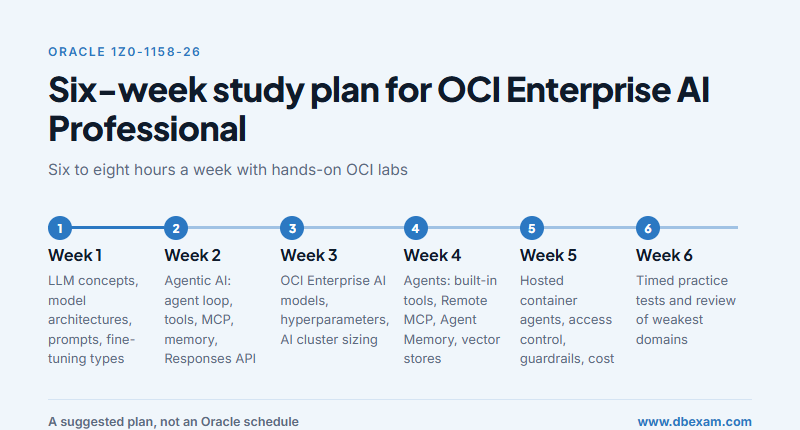
A workable plan for 1Z0-1158-26 is six weeks at six to eight hours a week. Spend the first two weeks on LLM and agentic theory, weeks three and four on OCI Enterprise AI models and agents, week five on hosted agents and governance, and week six on timed practice tests and targeted review of your weakest domain.
Week 1: LLM concepts and the platform map
Begin with the capabilities section so you know the three pillars of OCI Enterprise AI, then cover tokenisation, text generation, the three model architectures, prompt design and the types of fine-tuning. Take a timed practice test at the end of the week even though you have not covered most of the syllabus. Its job is to show your starting point, not to produce a pass.
Week 2: Agentic AI concepts
Study the perceive, reason, act and observe loop, tool categories, MCP, and short-term versus long-term memory. Then build a small agent with the Responses API. Writing even a few lines of code that make an agent call a tool and use the result teaches the agent loop more firmly than any diagram, and the syllabus explicitly asks you to build a working agent.
Week 3: OCI Enterprise AI models
Work through the pretrained foundation model families and what each is intended for, then customisation approaches and the hyperparameters used in fine-tuning and inference. Spend at least one session on dedicated AI clusters: what a unit shape is, how sizing differs between fine-tuning and hosting, which pricing options apply, and how an endpoint is configured.
Week 4: OCI Enterprise AI agents
This is the 25% domain, so give it a full week. Build an agent that uses each built-in tool at least once: File Search over documents you have uploaded and indexed, Code Interpreter on a data file, a Function tool, and an MCP call. Test the three memory options and note what changes. Finish by grounding an agent with the Vector Stores API and Files API.
Week 5: Hosted agents and governance
Package the agent from week four as a container image and deploy it through the hosted agent workflow. Then turn to governance: access controls for Enterprise AI resources, data protection at rest and in transit, guardrails for content, prompt injection and personal data, and the observability and cost tools you would use to run the agent in production.
Week 6: Timed practice and targeted review
Sit two or three full timed practice tests on separate days. After each one, list the questions you got wrong by domain and go back to the source material for those topics rather than re-reading everything. Book the exam once you score comfortably above the 68% pass mark on consecutive attempts and can explain why each wrong option is wrong.
If you already work with OCI generative AI services daily, you can compress the plan into four weeks by combining weeks one and two and weeks five and six. If you are new to OCI itself, add a week at the start for compartments, IAM policies, networking and the console, because the governance and hosted-agent questions assume that knowledge.
What mistakes cost candidates marks on 1Z0-1158-26?
The most expensive mistakes on 1Z0-1158-26 are studying general AI instead of OCI's own features, skipping hands-on work with the built-in agent tools, ignoring dedicated AI cluster sizing, confusing the three types of agent memory, and treating governance as common sense. Each one affects a domain worth at least 10% of the exam.
Studying AI in general instead of OCI Enterprise AI. Many candidates arrive with plenty of LLM experience from other platforms and assume it will carry them. The theory domains reward it, but they are 30% of the exam. The remaining 70% asks about OCI's own models, agents, hosted runtime and governance features, and those questions are answered from Oracle's documentation and labs, not from general knowledge.
Learning the tools from a list. Code Interpreter, File Search, MCP Calling and Function tools are easy to memorise as names. The exam asks which one fits a task, and that judgement comes from having used them. One afternoon building an agent that uses all four is worth more than several hours of reading descriptions.
Skipping cluster sizing and pricing. Dedicated AI cluster sizing, unit shapes, pricing options and endpoint configuration sit inside a 20% domain and are often left until last because they feel administrative. They produce precise questions with one correct answer, which makes them some of the most reliable marks on the exam for anyone who has practised them.
Mixing up memory types. Short-term memory, long-term memory and short-term memory compaction appear in two domains, once as general agentic concepts and again as OCI Agent Memory features. Make a one-line definition of each and a single example of when you would use it, and test yourself on symptoms rather than names.
Assuming governance is obvious. Guardrails for content moderation, prompt-injection defence and personal data each address a different risk, and access control addresses none of them. Questions in this domain often include an option that sounds secure but solves the wrong problem, such as tightening IAM policies when the requirement is to stop sensitive data appearing in a response.
Running out of time on long scenarios. Ninety minutes is enough for fifty questions only if you do not get stuck. Answer what you can on the first pass, flag the rest, and return to them with the time you have saved. A flagged question answered with a fresh read is more likely to be right than one you have stared at for five minutes.
What happens after you pass, and where do you find your score?
After the exam, Oracle makes your result available through its certification account, CertView, which is linked from Oracle MyLearn. Once you pass 1Z0-1158-26, the Oracle Cloud Infrastructure Certified Enterprise AI Professional credential is added to your record and Oracle issues a digital badge you can share with employers and on professional profiles.
Your score report shows whether you passed, and it can point to the exam topics where you answered incorrectly. If you do not pass, that topic feedback is the most useful study guide you will get for a second attempt: go back to those topics first, sit another timed practice test, and check Oracle's current retake policy on MyLearn before you rebook.
The credential is tied to the 2026 version of the exam. Oracle updates its OCI certifications as the services change, so expect to refresh your knowledge as OCI Enterprise AI adds features. Keeping the agent you built during preparation running in a personal tenancy is a simple way to stay current, because new tool and memory options become visible there first.
For employers, the credential signals someone who can take an AI agent from design to a governed production deployment on OCI, not just someone who has used a chatbot. That is the distinction the exam is built to test, and preparing for it with hands-on work and timed practice gives you both the badge and the skills behind it. For product details beyond the exam, Oracle's OCI Generative AI documentation is the reference to keep open while you build.
FAQs
How many questions are on the Oracle 1Z0-1158-26 exam and how long is it?
The Oracle 1Z0-1158-26 exam has 50 multiple-choice questions and a time limit of 90 minutes. That allows about one minute and forty-eight seconds per question. Many questions are short scenarios, so practise full-length timed tests and aim to finish a first pass with time left to review flagged items.
What is the passing score for 1Z0-1158-26?
The passing score for 1Z0-1158-26 is 68%, which means at least 34 correct answers out of 50. Because Building OCI Enterprise AI Agents alone carries 25% of the exam, a weak area there can use up most of your margin, so prepare across every domain rather than relying on favourites.
How much does the 1Z0-1158-26 exam cost?
The 1Z0-1158-26 exam costs USD 245 as of October 2026. Oracle notes that the price may vary by country or local currency, and taxes can apply. Register through Oracle MyLearn and confirm the amount shown in your account at the time of booking, along with Oracle's current rescheduling and retake terms.
Which certification does the 1Z0-1158-26 exam lead to?
Passing 1Z0-1158-26 earns the Oracle Cloud Infrastructure Certified Enterprise AI Professional credential. It is a professional-level certification on the Oracle Cloud Infrastructure 2026 track, aimed at engineers, architects and developers who design, build, deploy and govern AI agents on OCI Enterprise AI.
Which 1Z0-1158-26 syllabus domain carries the most weight?
Building OCI Enterprise AI Agents carries the most weight at 25%. Applying Agentic AI Concepts and Configuring OCI Enterprise AI Models follow at 20% each, Building and Deploying Hosted Agents is 15%, and the LLM concepts and governance domains are 10% each.
Does Oracle sell an official question bank for the 1Z0-1158-26 exam?
Oracle does not sell a public question bank for 1Z0-1158-26. Its own preparation route is a MyLearn course series named Become an OCI Enterprise AI Professional. DBExam's practice test is an independent timed simulator built on the same syllabus and format, not Oracle material.
- Oracle Cloud Infrastructure |
- 1Z0-1158-26 |
- Oracle 1Z0-1158-26 Questions and Answers |
- Oracle Cloud Infrastructure Certified Enterprise AI Professional |
- 1Z0-1158-26 Study Guide |
- 1Z0-1158-26 Practice Test |
- Oracle Cloud Infrastructure Enterprise AI Professional Certification Questions |
- 1Z0-1158-26 Sample Questions |
- 1Z0-1158-26 Simulator |
- Oracle Cloud Infrastructure Enterprise AI Professional Online Exam |
- Oracle Cloud Infrastructure Enterprise AI Professional |
- 1Z0-1158-26 Certification |
- Cloud Infrastructure Enterprise AI Professional Exam Questions |
- Cloud Infrastructure Enterprise AI Professional |
- 1Z0-1158-26 Study Guide PDF |
- 1Z0-1158-26 Online Practice Test |
- Oracle Cloud Infrastructure 2026 Mock Test |
- 1Z0-1158-26 Test Questions |
- 1Z0-1158-26 Exam Guide |
- 1Z0-1158-26 Study Material |
- 1Z0-1158-26 Syllabus |
- Oracle Cloud Infrastructure Enterprise AI Professional Syllabus |
- Oracle Cloud Infrastructure Enterprise AI Professional Prep Guide |
- 1Z0-1158-26 Certification Exam Cost


