
Most Oracle 1Z0-830 Prep Misses This One Key Detail
Oracle Java SE 21 Developer Professional certification, identified by exam code 1Z0-830, stands as a critical benchmark for Java developers aiming to validate their expertise with the latest long-term support (LTS) release of the Java SE platform. This credential signifies a deep understanding of core Java programming, object-oriented principles, and advanced features essential for building robust, modern applications. It is designed for experienced Java developers who are ready to prove their proficiency in a professional setting, demonstrating readiness for demanding software development roles.
This comprehensive guide delves into the specifics of the Oracle 1Z0-830 exam, highlighting not just what to study, but how to approach the preparation with a crucial insight often overlooked by candidates. We will explore the exam's structure, detailed syllabus, and effective strategies for passing, ensuring you grasp the interconnectedness of Java concepts rather than merely memorizing syntax. Understanding this one key detail can fundamentally transform your study regimen and boost your confidence on exam day.
Establishing Foundational Understanding for Oracle 1Z0-830
The Oracle Java SE 21 Developer Professional exam assesses a candidate's ability to apply core Java SE 21 features effectively in practical scenarios. It isn't merely a test of recall; it evaluates how well a developer can design, implement, and troubleshoot Java applications using the latest standards. This certification serves as a robust indicator to employers of a developer's up-to-date skills and their capability to contribute immediately to projects leveraging Java SE 21.
Candidates pursuing this certification typically possess several years of experience in Java development, comfortable with complex programming constructs and best practices. The 1Z0-830 validates a developer's professional standing and commitment to continuous learning within the rapidly evolving Java ecosystem, offering a clear career advantage.
Oracle 1Z0-830 Examination Parameters
Understanding the administrative details of the Oracle 1Z0-830 exam is the first step in strategic preparation. These parameters define the testing environment and performance expectations, allowing candidates to set realistic goals and manage their time effectively during the exam. Being fully aware of these specifics helps alleviate anxiety and allows for a more focused approach to studying.
-
Exam Name: Oracle Java SE 21 Developer Professional
-
Exam Code: 1Z0-830
-
Exam Price: USD $245 (Pricing may vary by country or by localized currency)
-
Duration: 120 minutes
-
Number of Questions: 50
-
Passing Score: 68%
Each of these points contributes to forming a complete picture of the challenge ahead. The 120-minute duration for 50 questions translates to roughly 2.4 minutes per question, emphasizing the need for quick, accurate problem-solving without excessive deliberation. A passing score of 68% demands not just broad knowledge but a solid command of the core objectives.
Unpacking the Core Java SE 21 Developer Professional Syllabus
The syllabus for the Oracle 1Z0-830 exam is meticulously designed to cover the breadth and depth of Java SE 21 development. It reflects the essential skills required for a professional Java developer today, ranging from fundamental data handling to advanced concurrent programming and localization. A thorough understanding of each topic and its practical implications is paramount.
The key detail often missed in preparation revolves around the interconnectedness of these topics. Many candidates study each syllabus item in isolation, failing to grasp how they combine to form real-world applications. The exam often tests this integration, presenting scenarios that require knowledge from multiple domains simultaneously.
-
Handling Date, Time, Text, Numeric and Boolean Values: This foundational module ensures proficiency in managing various data types, crucial for all Java applications.
-
Controlling Program Flow: Mastery of loops, conditionals, and decision-making structures is vital for creating dynamic and responsive code.
-
Using Object-Oriented Concepts in Java: A deep dive into encapsulation, inheritance, polymorphism, and abstraction, which form the bedrock of Java programming.
-
Handling Exceptions: Understanding how to manage errors and unexpected events gracefully is key to building robust and resilient software.
-
Working with Arrays and Collections: Proficiency in data structures, including various collection types and their appropriate use cases.
-
Working with Streams and Lambda expressions: Modern Java development heavily relies on functional programming paradigms for efficient data processing.
-
Packaging and Deploying Java Code: Knowledge of how to create JARs, modules, and deploy applications, covering the full lifecycle of a Java project.
-
Managing Concurrent Code Execution: Handling multi-threaded programming and synchronization to build high-performance, responsive applications.
-
Using Java I/O API: Input/Output operations are fundamental for interacting with files, networks, and other external resources.
-
Implementing Localization: Developing applications that can adapt to different languages and regional settings, a crucial skill for global software.
Each topic, while important individually, often appears in combination with others within exam questions. For instance, a question on Streams might involve date/time manipulation or exception handling, challenging a candidate's holistic understanding. Ignoring these synergistic relationships is the "one key detail" most candidates overlook.
Bridging Theory to Practical Implementation: The Oracle 1Z0-830 Advantage
Many aspiring Java professionals approach the 1Z0-830 by focusing heavily on theoretical knowledge and API specifications. While essential, this method frequently misses the critical link: how these theoretical concepts translate into practical, efficient, and maintainable code within a real-world application. The true value of this certification, and the challenge of the exam, lies in demonstrating this bridge.
The key detail often overlooked is the exam's implicit focus on best practices and idiomatic Java. It's not just about knowing that a feature exists, but when and how to use it most effectively, considering performance, readability, and future maintainability. Oracle seeks certified professionals who can write production-ready code, not just academic exercises.
Cultivating Real-World Application Skills
Success in the Oracle Java SE 21 Developer Professional exam requires more than just memorizing class names and method signatures. It demands a deep understanding of problem-solving with Java. This involves thinking critically about a given scenario and selecting the most appropriate Java SE 21 features to achieve the desired outcome efficiently and robustly. This is where many preparation approaches fall short, prioritizing breadth over depth and practical application.
Consider the syllabus topics: managing concurrent code, working with streams, and using the I/O API. Each of these can be tested in isolation, but the most challenging and insightful questions will often blend them. For instance, you might encounter a scenario where you need to process a large file (I/O) concurrently (concurrency) using functional constructs (streams and lambdas) to achieve a specific result. Understanding Oracle documentation examples can significantly enhance this practical perspective.
-
Integrated Problem Solving: Develop solutions that combine elements from different syllabus areas.
-
Performance Awareness: Understand the implications of different API choices on application performance and resource usage.
-
Error Handling Strategies: Implement robust exception handling that anticipates various failure points in complex systems.
-
Design Patterns: Recognize how object-oriented principles are applied through common design patterns, even if not explicitly named in the syllabus.
The ability to integrate these concepts effectively is the hallmark of a true Java professional and the central focus of the 1Z0-830 exam's "key detail."
Mastering Complex Java SE 21 Features
Java SE 21 introduces and refines many powerful features. Simply being aware of their existence isn't enough; the exam expects candidates to demonstrate mastery. This means understanding their internal workings, common pitfalls, and advanced usage scenarios. For example, while Streams and Lambda expressions simplify data processing, misusing them can lead to inefficient or difficult-to-debug code.
Candidates often prepare by covering each feature independently. However, the exam frequently presents scenarios where the optimal solution requires combining these features synergistically. For instance, a question might involve processing a collection of custom objects using streams, filtering based on specific criteria, and then collecting the results into a new data structure, all while handling potential null values or exceptions.
To truly master these features, it's beneficial to:
-
Code Regularly: Implement small projects or solve coding challenges that force you to use different API combinations.
-
Deep Dive into Javadocs: Read the official documentation for classes and methods beyond the basic usage examples.
-
Experiment with Edge Cases: Test how features behave under unusual conditions or with invalid inputs to understand their limitations.
-
Review Best Practices: Study common coding conventions and design patterns applicable to modern Java development.
This approach moves beyond surface-level understanding, equipping you with the practical acumen that the Oracle 1Z0-830 truly seeks to validate.
Strategic Preparation for Oracle 1Z0-830 Certification Success
Approaching the Oracle 1Z0-830 exam with a clear, strategic plan is essential. Many candidates fall into the trap of passive learning, reading documentation or watching videos without actively engaging with the material. To truly internalize the "key detail" of practical application and interconnectedness, an active, hands-on methodology is indispensable.
Effective preparation transcends simple memorization; it requires active problem-solving, coding, and regular self-assessment. The goal is to build a robust understanding that can adapt to various problem statements presented in the exam, rather than hoping for familiar questions.
Developing a Focused Study Regimen
A structured study plan is the backbone of successful certification preparation. Begin by thoroughly reviewing the official syllabus and cross-referencing it with your current knowledge. Identify areas of weakness and allocate more study time to them. Don't shy away from complex topics; these are often where the integrated, scenario-based questions reside.
Prioritize hands-on coding. Simply reading about streams or concurrency won't ingrain the understanding necessary to debug a concurrent issue or optimize a stream pipeline in a timed exam setting. Setting up a dedicated development environment and consistently writing code snippets for each topic is crucial. Furthermore, leveraging Oracle 1Z0-830 practice questions can significantly enhance your self-assessment, allowing you to gauge your readiness and identify further areas for improvement.
Key components of a focused study regimen include:
-
Syllabus Mapping: Create a detailed checklist from the syllabus, marking your confidence level for each point.
-
Dedicated Coding Sessions: Spend significant time writing and testing code for every API and concept.
-
Concept Reinforcement: Explain complex topics in your own words or to a peer, solidifying your understanding.
-
Time Management: Practice solving problems under timed conditions to improve speed and accuracy.
This active engagement ensures you're not just passively absorbing information but actively developing the problem-solving muscles required for the exam.
Avoiding Common Preparation Pitfalls
Many candidates, despite their best efforts, falter in their Oracle 1Z0-830 preparation due to common mistakes. One significant pitfall is relying solely on theoretical knowledge without practical application. Another is underestimating the exam's emphasis on subtle differences between API calls or nuanced behaviors of specific Java features. This ties directly back to the "key detail" of comprehensive, interconnected understanding.
Another common mistake is neglecting specific syllabus sections, particularly those perceived as less critical or more challenging. The 68% passing score indicates that a broad and deep understanding across all topics is necessary. Skipping areas like localization or certain I/O intricacies can lead to losing crucial points.
To steer clear of these traps:
-
Do Not Rely on Dumps: Using unauthorized "dumps" is unethical, often provides outdated or incorrect information, and undermines true learning, leading to eventual failure in real-world application.
-
Practice with Purpose: Don't just complete practice questions; analyze why correct answers are correct and why incorrect answers are wrong.
-
Focus on Integration: Actively seek out opportunities to combine different syllabus concepts in your coding exercises.
-
Diversify Learning Resources: Supplement official Oracle documentation with books, online courses, and community forums. Understanding community discussions can provide valuable context and alternative perspectives.
By consciously avoiding these pitfalls, candidates can build a more robust and effective preparation strategy, aligning their efforts with the true intent of the 1Z0-830 certification.
Validated Skills and Career Momentum from Oracle 1Z0-830
The Oracle 1Z0-830 certification goes beyond merely proving a developer's knowledge; it signifies a capability to apply advanced Java SE 21 features in complex software engineering challenges. This level of validation is highly regarded in the industry, opening doors to more sophisticated roles and career advancement opportunities. It's a statement of current relevance and future potential in the Java development landscape.
The "key detail" here is that the certification proves you are not just a coder, but a thoughtful engineer capable of making informed architectural and implementation decisions using the latest Java constructs. This translates directly into increased employability and higher earning potential, making the investment in time and effort truly worthwhile.
Advancing Your Expertise in Java SE 21 Development
Earning the Oracle Java SE 21 Developer Professional certification demonstrates a commitment to mastering the most current stable release of Java. This is crucial in a field where technologies evolve rapidly. The skills validated by the 1Z0-830 are directly applicable to building enterprise-grade applications, microservices, and high-performance computing solutions.
The certification confirms your ability to:
-
Architect Robust Solutions: Design systems that are efficient, scalable, and resilient, leveraging Java SE 21 features like modularity and enhanced concurrency.
-
Optimize Performance: Write code that performs well, understanding the implications of I/O operations, stream pipelines, and concurrent access.
-
Maintain Code Quality: Implement clean, readable, and maintainable Java code that adheres to industry best practices, including effective exception handling and object-oriented design.
-
Adapt to Modern Paradigms: Embrace functional programming with streams and lambdas, essential for modern data processing and API design.
This advanced expertise makes certified professionals valuable assets to any development team, capable of tackling diverse and challenging projects with confidence and competence.
Forecasting Career Trajectories with Oracle Certification
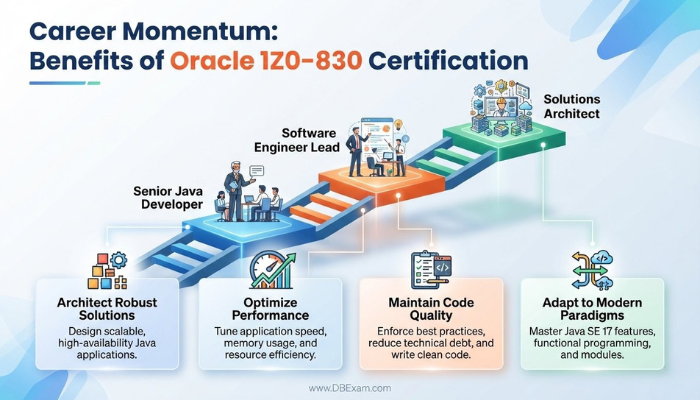
The Oracle Java SE 21 Developer Professional certification significantly enhances a developer's career prospects. It provides tangible evidence of a skill set that is in high demand across various industries. Employers often prioritize certified individuals, viewing them as proven performers who require less initial training and can contribute more effectively from day one.
While salary expectations can vary widely based on location, experience, and specific role, holding this certification typically positions a developer at the higher end of the spectrum for roles requiring Java SE 21 expertise. The certification signals not just technical proficiency but also professionalism and dedication, qualities that are highly valued in the workforce. This credential can lead to opportunities such as:
-
Senior Java Developer
-
Software Engineer Lead
-
Solutions Architect
-
Technical Consultant
-
Full-stack Developer specializing in Java backends
The impact of this certification extends beyond a single job; it establishes a foundation for continuous career growth and specialization in the ever-expanding world of Java technologies. It’s a strategic move for any developer serious about their professional journey.
Evaluating Your Preparedness for the Oracle 1Z0-830 Exam
Before scheduling your Oracle 1Z0-830 exam, an honest and thorough self-assessment of your preparedness is crucial. Many candidates rush this step, leading to suboptimal performance and the need for re-examination. The key detail in this phase is to evaluate not just what you know, but how confidently and accurately you can apply that knowledge under pressure, especially concerning the interconnectedness of concepts.
This evaluation phase should mimic the actual exam experience as closely as possible, focusing on scenario-based questions that require multi-topic solutions. It's about identifying remaining gaps in your understanding and refining your approach to complex problems.
Assessing Your Current Skill Set for Oracle Java SE 21
A comprehensive assessment of your Java SE 21 skills should go beyond simple multiple-choice questions. Engage in practical coding challenges that require you to implement solutions for problems covering various syllabus topics simultaneously. For example, can you write a concurrent application that reads data from a file, processes it using streams, handles potential I/O errors, and then writes the results to another location?
Pay close attention to topics like concurrency management and stream API complexities. These areas often present the most nuanced questions, requiring a deep understanding of their behaviors and optimal use cases. If you find yourself struggling to integrate these concepts, it's a clear sign that further hands-on practice is needed. The goal is to feel confident not just in theoretical knowledge but in practical execution.
Effective self-assessment includes:
-
Timed Practice Exams: Simulate the 120-minute exam duration and 50-question format to gauge your pace and endurance.
-
Code Review: Review your own practice code for efficiency, correctness, and adherence to best practices.
-
Scenario Analysis: Break down complex problem statements into smaller, manageable parts, identifying which Java features are most appropriate for each.
-
Concept Articulation: Try to explain complex Java SE 21 concepts aloud, solidifying your understanding and identifying areas of confusion.
This rigorous self-evaluation ensures that you are truly ready to demonstrate professional-level Java SE 21 development skills.
Finalizing Your Readiness: Beyond Memorization
The "one key detail" that often differentiates successful Oracle 1Z0-830 candidates from those who struggle is the ability to move beyond rote memorization to true comprehension. The exam isn't designed to test your ability to recall arbitrary facts but your capacity to analyze a problem and apply Java SE 21 solutions intelligently. This means understanding the underlying principles and design choices behind the Java APIs.
As you approach your exam date, shift your focus from learning new material to solidifying existing knowledge through application. Practice debugging code, anticipating runtime exceptions, and refactoring inefficient solutions. This active problem-solving mindset is what the certification truly aims to validate.
Key indicators of final readiness include:
-
Consistent High Scores: Achieving consistently strong results in timed practice tests, particularly on questions that combine multiple syllabus topics.
-
Confidently Explaining Solutions: Being able to articulate not just the answer to a coding problem, but the 'why' behind the chosen approach and alternative solutions.
-
Debugging Proficiency: Quickly identifying and resolving logical errors or runtime issues in Java code snippets.
-
Understanding Nuances: Grasping subtle differences between similar API methods or the impact of different modifiers on class and member behavior.
By mastering this profound understanding and practical application, you ensure that you are not just prepared to pass the exam, but genuinely ready to excel as an Oracle Java SE 21 Developer Professional.
Conclusion
The Oracle Java SE 21 Developer Professional (1Z0-830) certification is a powerful credential that affirms your expertise in modern Java development. However, simply knowing the syllabus items isn't enough. The most critical detail often missed in preparation is the necessity of understanding the interconnectedness of Java SE 21 features and their practical, idiomatic application in complex scenarios. Success hinges on moving beyond isolated facts to a holistic, problem-solving mindset.
By focusing on hands-on coding, integrating diverse syllabus topics, and engaging in critical self-assessment that mimics real-world challenges, you can truly master the skills Oracle seeks to validate. This approach not only prepares you for the exam but also hones your abilities as a highly capable Java developer, ready to tackle the demands of modern software engineering.
Embark on your journey to becoming an Oracle Java SE 21 Developer Professional with a clear strategy. To further enhance your preparation and explore a wide range of study materials, including sample questions and detailed guides, explore Oracle certifications on our platform. Your commitment to deep, integrated understanding will be your greatest asset in achieving this esteemed certification and advancing your career.
FAQs
1. What is the Oracle 1Z0-830 certification?
The Oracle 1Z0-830 is the exam for the Oracle Java SE 21 Developer Professional certification, which validates a developer's expertise in core Java SE 21 programming, object-oriented principles, and advanced features for building robust applications.
2. Who should consider taking the Oracle Java SE 21 Developer Professional exam?
This exam is ideal for experienced Java developers who want to validate their proficiency with Java SE 21, demonstrate up-to-date skills, and enhance their career prospects in roles requiring advanced Java development capabilities.
3. What is the primary focus of the 1Z0-830 exam's content?
The 1Z0-830 exam focuses on assessing a candidate's ability to apply core Java SE 21 concepts in practical, real-world scenarios, emphasizing the integrated use of features like streams, concurrency, and I/O, rather than just isolated theoretical knowledge.
4. How should I approach studying for the Oracle 1Z0-830 to avoid common pitfalls?
Effective study involves extensive hands-on coding, practicing integrated problem-solving across multiple syllabus topics, utilizing timed practice questions, and avoiding reliance on memory-based dumps. Focus on understanding "why" and "how" features are used, not just "what" they are.
5. What career benefits can I expect after achieving the Oracle Java SE 21 Developer Professional certification?
Achieving this certification can significantly boost your career by validating advanced skills, increasing employability, potentially leading to higher salary expectations, and opening doors to senior developer, architect, and lead engineering roles in the Java ecosystem.
- Oracle Java SE |
- 1Z0-830 |
- Oracle 1Z0-830 Questions and Answers |
- 1Z0-830 Study Guide |
- 1Z0-830 Practice Test |
- Oracle Java SE Developer Professional Certification Questions |
- 1Z0-830 Sample Questions |
- 1Z0-830 Simulator |
- Oracle Java SE Developer Professional Online Exam |
- 1Z0-830 Certification |
- Java SE Developer Professional Exam Questions |
- Java SE Developer Professional |
- 1Z0-830 Study Guide PDF |
- 1Z0-830 Online Practice Test |
- Java 21 Mock Test |
- 1Z0-830 Test Questions |
- 1Z0-830 Exam Guide |
- 1Z0-830 Study Material |
- 1Z0-830 Syllabus |
- Oracle Java SE Developer Professional Prep Guide |
- 1Z0-830 Certification Exam Cost |
- Oracle Certified Professional Java SE 21 Developer |
- Oracle Java SE 21 Developer Professional |
- Oracle Java SE 21 Developer Professional Syllabus


